


|
Name of
Geometrical tool |
Use of
Geometrical tool |
|
Divider |
Comparing
lengths. |
|
Protractor |
Measure as well
as draw angles. |
|
Set Squares |
To draw parallel
and perpendicular lines. |
|
Compass |
To draw
circles, arcs, and to mark equal lengths. |
|
Ruler |
To measure
lengths of the line segment and to draw a line segment. |
Tools used for construction:
- Ruler: An instrument used to draw line segments and measure their lengths.
- Compass: Instrument having a pointer on one end and a pencil on the other end. It is used to mark equal lengths and to draw circles and arcs.
- Divider: Instrument having a pair of pointers. It is used to compare lengths.
- Set- Squares: Two triangular pieces – One of them has 45°, 45°, 90° and the other has 30°, 60°, 90° angles at the vertices. It is used to draw parallel and perpendicular lines.
- Protractor: A semicircular instrument graduated into 180° parts. It is used to draw and measure angles.
Tools used for construction:
- Ruler: An instrument used to draw line segments and measure their lengths.
- Compass: Instrument having a pointer on one end and a pencil on the other end. It is used to mark equal lengths and to draw circles and arcs.
- Divider: Instrument having a pair of pointers. It is used to compare lengths.
- Set- Squares: Two triangular pieces – One of them has 45°, 45°, 90° and the other has 30°, 60°, 90° angles at the vertices. It is used to draw parallel and perpendicular lines.
- Protractor: A semicircular instrument graduated into 180° parts. It is used to draw and measure angles.
Line Segment
Line Segment
Line Segment: Part of a line that is bounded by two distinct endpoints.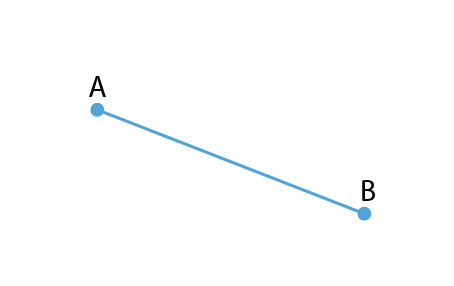 Constructing a Line Segment for a given LengthSteps for constructing a line segment of a given length ‘a’:(i) Draw a line l and mark a point A on it.
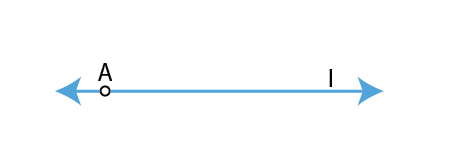 (ii) Place the compass on the initial point of the ruler. Open it to place pencil point up to the ‘a’ mark.(iii) Place the pointer on A and draw an arc to cut l at B. AB is the required line segment.Constructing Copy of a Line SegmentSteps for constructing a copy of a given line segment using ruler and compass together:(i) Given AB whose length is unknown.(ii) Fix compass’ pointer on A and pencil end on B. The opening of the instrument now gives the length of AB.(iii) Draw any line l.(iv) Placing the pointer on C, draw an arc that cuts l at a point say D. Then, CD = AB.
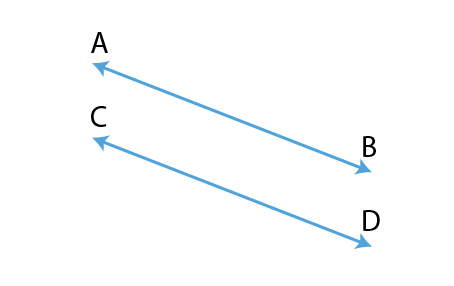
Perpendiculars and ParallelsA line MN meeting another line AB at the right angle is said to be the perpendicular to the line AB.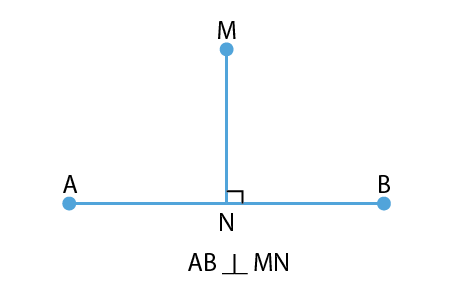 If two lines are non-intersecting and are always the same distance apart, then they are said to be parallel lines.As shown in the figure, AB || CD.
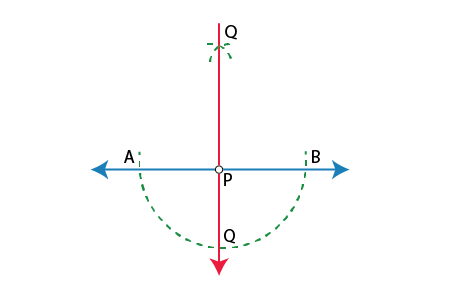
 Constructing a Perpendiculars Using a Compass and RulerSteps for constructing perpendiculars using compass and rulers:(i) Given a line I and a point P not on it.(ii) With P as the centre, draw an arc which intersects line I at two points A and B.(iii) Using the same radius and with A and B as centres, construct two arcs that intersect at a point, say Q, on the other side.(iv) Join PQ. Thus, is the perpendicular to l.
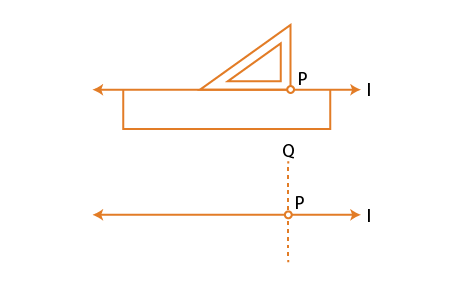
 Constructing Perpendicular to a Line through a Point on the LineSteps to construct a perpendicular to a line through a point on the line:(i) Place a ruler along a given line l such that one of its edges is along l. (ii) Place a set square with one of its edges along the already aligned edge of the ruler.(iii) Slide the set square such that its right-angled corner coincides with the Point P.(iv) Draw PQ and PQ are perpendicular to l.
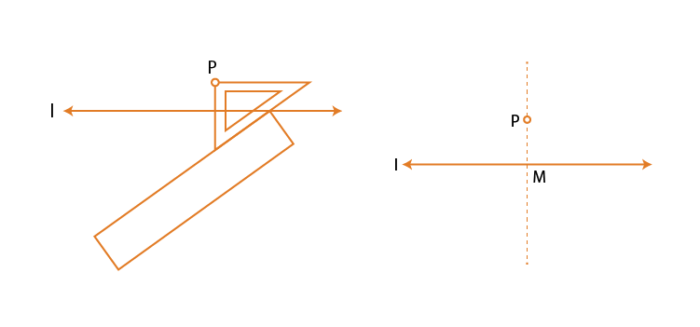
 Paper Folding ConstructionPaper folding method to make perpendiculars:(i) Let l be the given line and P be a point outside l.(ii) Place a set-square on l such that one arm of its right angle aligns along l.(iii) Place a ruler along the edge opposite to the right angle of the set-square.(iv) Slide the set-square along the ruler till the point P touches the other arm of the set-square.
 CircleA circle is a set of all points in a plane that are equidistant from a point i.e. centre of the circle.Construction of a Circle for a given RadiusSteps for constructing a circle using a compass:(i) Open compass for the required radius.(ii) Place pointer of the compass on O.(iii) Rotate the compass slowly to draw the circle.
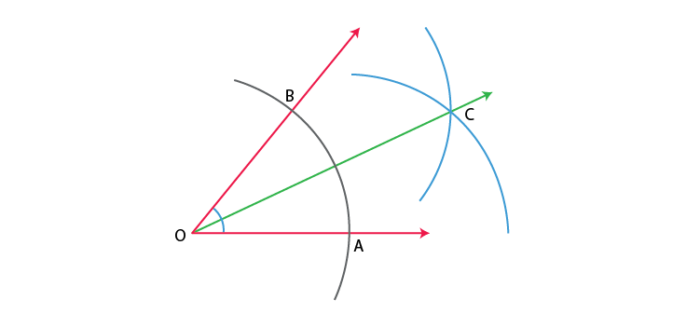
 How to Construct an AngleAngle Bisector and Its ConstructionSteps to construct angle bisectors of a given angle:(i) With O as the centre, draw an arc that cuts both rays at A and B.(ii) With B as the centre, draw an arc whose radius is more than half of the length of AB.(iii) With A as the centre, with the same radius, cut an arc in the interior of ∠BOA(iv) Mark point of intersection as C. Then, OC is the angle bisector.
 Construction of 30°, 60°, 90°and 120°Angles(i) Construction of 60° angle:
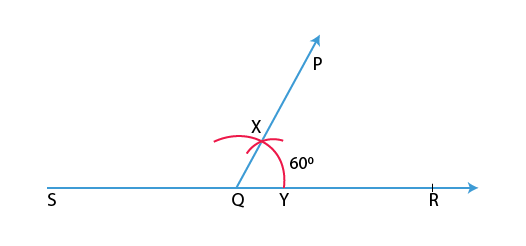 (ii) Construction of 120°angle:
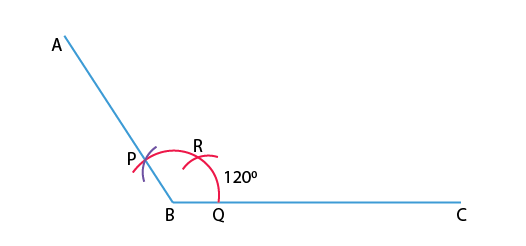 (iii) Construction of 90° angle:
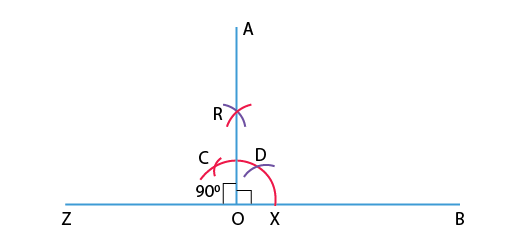 (iv) Construction of 30° angle:
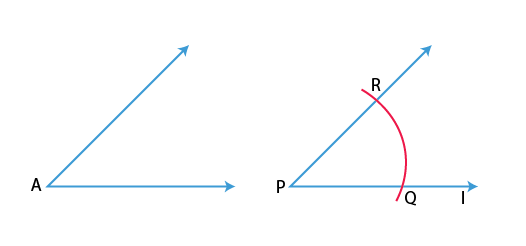
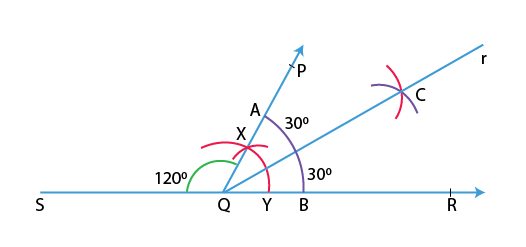 Constructing of an Angle with Unknown MeasurementSteps for constructing a copy of an angle with unknown measurement:(i) Draw a line l and choose a point P on it.(ii) Place compass’ pointer at A and draw an arc to cut the rays of ∠A at B and C.(iii) Draw an arc with P as the centre, cutting /at Q.(iv) Set your compasses to length BC with the same radius.(v) Place the compasses pointer at Q and draw an arc to cut the arc drawn earlier in R.(vi) Join PR. This gives ∠P=∠A
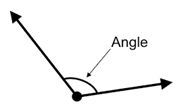
 AnglesAngles: Formed by two rays sharing a common endpoint.
 ASSIGNMENTStudy and practice Ch-13 and do Self Practice 13 full, page-230.
R/38 10/02/2022 PERIODIC TEST-04


The organization of data can be done in various ways. One way to organize data is by using tally marks. Tally marks are a way of expressing numbers in groups of 5. The numbers are represented as follows: Another way of organizing data is through the use of pictographs. A pictograph represents data through pictures of objects. It helps answer the questions on the data at a glance. For e.g. the following table shows the no of apples sold by a vendor during a week:
 Maximum number of apples were sold on Monday that is, 50 apples since there are 5 pictures. On Wednesday, no apples were sold as there is no picture.The following examples illustrate the use of above methods:
Problem: Following is the choice of sweets of 30 students of Class VI.Ladoo, Barfi, Ladoo, Jalebi, Ladoo, Rasgulla, Jalebi, Ladoo, Barfi, Rasgulla, Ladoo, Jalebi, Jalebi, Rasgulla, Ladoo, Rasgulla, Jalebi, Ladoo, Rasgulla, Ladoo, Ladoo, Barfi, Rasgulla, Rasgulla, Jalebi, Rasgulla, Ladoo, Rasgulla, Jalebi, Ladoo.- Arrange the names of sweets in a table using tally marks.
- Which sweet is preferred by most of the students?
 Ladoo is most preferred by people as 11 people prefer it.
Problem: The number of girl students in each class of a co-educational middle school is depicted by the pictograph: Observe this pictograph and answer the following questions:(a) Which class has the minimum number of girl students?(b) Is the number of girls in Class VI less than the number of girls in Class V?(c) How many girls are there in Class VII?
Solution:Class 8 has minimum number of girls. It has more than 4 but less than 8 girls.No, class 6 has 16 girls (4×4) while class 5 has less than 16.Class 7 is represented by 3 pictures. Thus, it has 3×4 = 12 girls.
BAR GRAPHBar graphs are the pictorial representation of data (generally grouped), in the form of vertical or horizontal rectangular bars, where the length of bars are proportional to the measure of data. They are also known as bar charts. Bar graphs are one of the means of data handling in statistics.The collection, presentation, analysis, organization, and interpretation of observations of data are known as statistics. The statistical data can be represented by various methods such as tables, bar graphs, pie charts, histograms, frequency polygons, etc. In this article, let us discuss what is a bar chart, different types of bar graphs, uses, and solved examples.
What is Bar Graph?The pictorial representation of grouped data, in the form of vertical or horizontal rectangular bars, where the lengths of the bars are equivalent to the measure of data, are known as bar graphs or bar charts.The bars drawn are of uniform width, and the variable quantity is represented on one of the axes. Also, the measure of the variable is depicted on the other axes. The heights or the lengths of the bars denote the value of the variable, and these graphs are also used to compare certain quantities. The frequency distribution tables can be easily represented using bar charts which simplify the calculations and understanding of data.
The three major attributes of bar graphs are:
- Arrange the names of sweets in a table using tally marks.
- Which sweet is preferred by most of the students?
- The bar graph helps to compare the different sets of data among different groups easily.
- It shows the relationship using two axes, in which the categories on one axis and the discrete values on the other axis.
- The graph shows the major changes in data over time.
Drawing a Bar GraphTo draw a bar graph, first of all draw a horizontal line and a vertical line. On the
Horizontal line we will draw bars representing the data (numbers) and on vertical line we will write numerals .which shows what data is being represented.
Same data can also be represented by interchanging the items on horizontal and vertical axis.It is important to take bars of same width keeping uniform gap between them. Next, a scale is chosen if needed. The scale varies according to the data given.Following problems explain how a bar graph is drawn:
Problem: The number of Mathematics books sold by a shopkeeper on six consecutive days is shown below: Draw a bar graph to represent the above information choosing the scale of your choice.Solution:To draw a bar graph, days are taken on horizontal axis and the number of books sold is taken on the vertical axis.The scale taken for representing this data is 1 unit length = 5 shirts. This scale is taken along the vertical line since the number of books is marked on the y axis.The height of the bars for various days is:
 Problem: Observe this bar graph which shows the marks obtained by Aziz in half-yearly examination in different subjects. Answer the given questions.
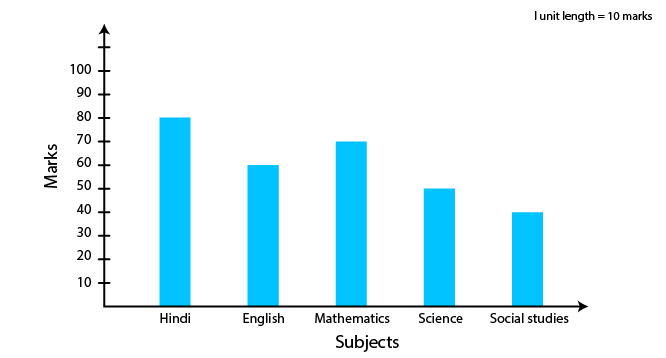 (a) What information does the bar graph give?(b) Name the subject in which Aziz scored maximum marks.(c) Name the subject in which he has scored minimum marks.(d) State the name of the subjects and marks obtained in each of them.
Solutions:(a) The bar graph shows the marks scored by Aziz in different subjects.(b) Aziz scored maximum marks in Hindi i.e 80 marks(c) Aziz scored minimum marks in Social Studies i.e 40 marks(d) Hindi – 80 marks English – 60 marks Mathematics – 70 marks
Science – 50 marks Social Studies – 40 marks
Problem: Following table shows the number of bicycles manufactured in a factory during the years 1998 to 2002. Illustrate this data using a bar graph. Choose a scale of your choice. (a) In which year were the maximum number of bicycles manufactured?(b) In which year were the minimum number of bicycles manufactured?
Solutions:By taking a scale of 1 unit length = 100 bicycles we may draw a bar graph of above data as follows.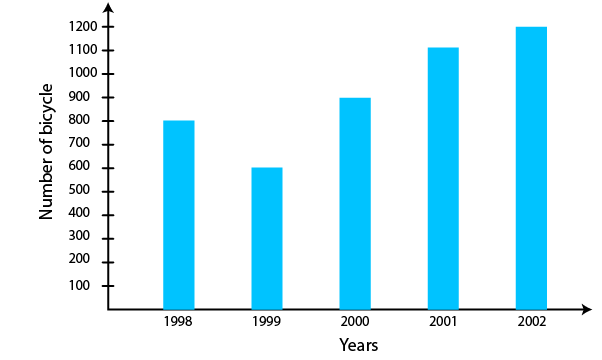 (a) In the year 2002, maximum number of bicycles were manufactured i.e 1200 bicycles(b) In the year 1999, minimum number of bicycles were manufactured i.e 600 bicycles.
ASSIGNMENTSDo Chapter-15 all exercises and Chapter Test.
R/31 11/01/2022, 12/01/2022 


 ASSIGNMENTSRevise Chapter-6 all exercises.
- The bar graph helps to compare the different sets of data among different groups easily.
- It shows the relationship using two axes, in which the categories on one axis and the discrete values on the other axis.
- The graph shows the major changes in data over time.



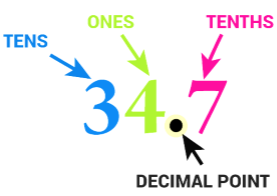
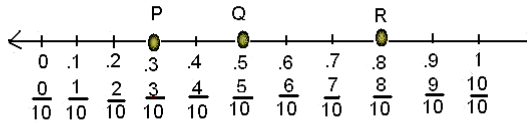
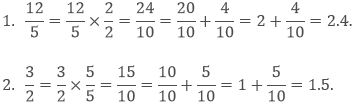
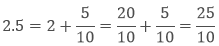
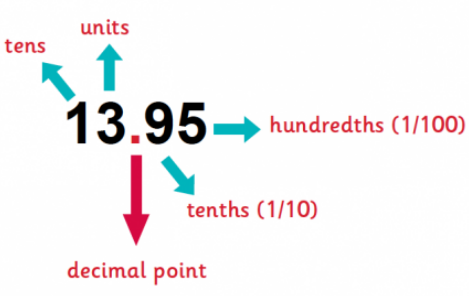
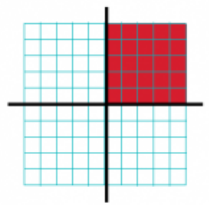
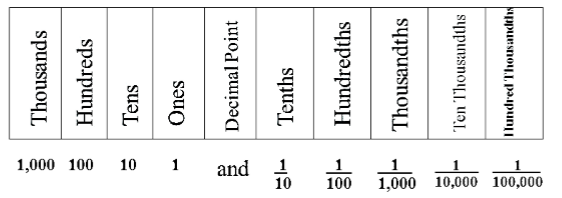

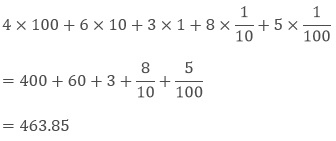
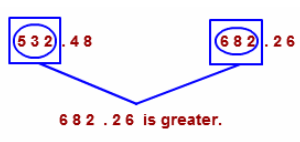
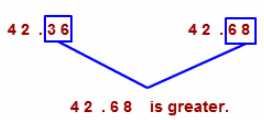
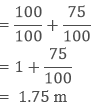
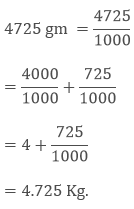
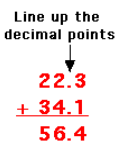
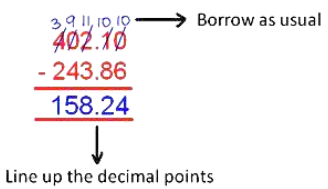
Write the numbers in a line so that the decimal points of both the numbers lined up.
Then subtract and borrow as we do in whole numbers.
Line up the decimal point in the answer also.
Write the numbers in a line so that the decimal points of both the numbers lined up.
Then subtract and borrow as we do in whole numbers.
Line up the decimal point in the answer also.


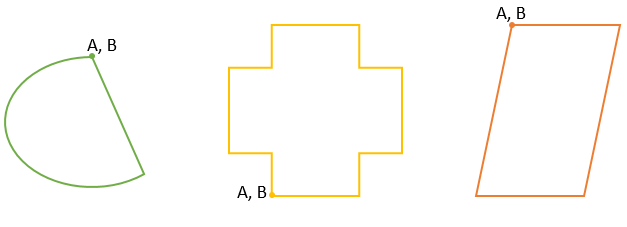

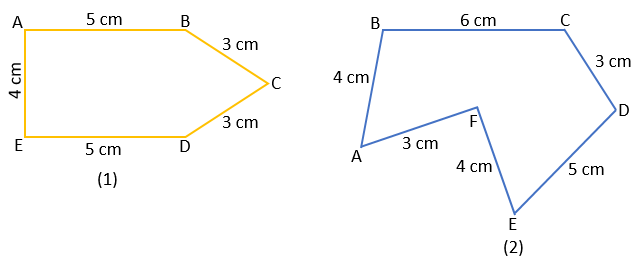
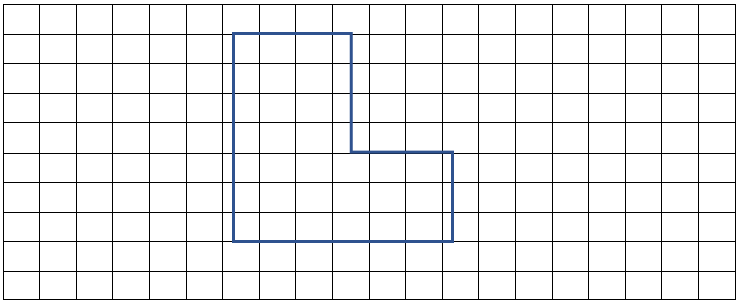
- The square which is completely covered under the figure, counted as a full square.
- The square which is half covered under the figure, counted as half square.
- The square which is covered less than half, is not counted.
- The square which is covered more than half, counted as a full square.




|
Name of 3D shape: |
Picture of 3D shape: |
Attributes: |
|
Cube |
|
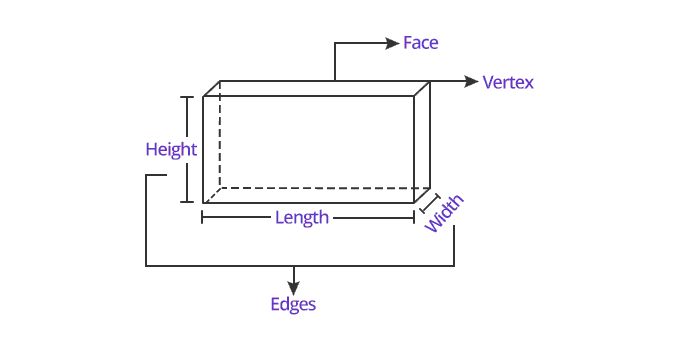
Faces - 6 Edges - 12 Vertices - 8 |
|
Rectangular Prism or Cuboid |
|
Faces - 6 Edges - 12 Vertices - 8 |
|
Sphere |
|
Curved Face - 1 Edges - 0 Vertices - 0 |
|
Cone |
|
Flat Face - 1 Curved Face - 1 Edges - 1 Vertices - 1 |
|
Cylinder |
|
Flat Face - 2 Curved Face - 1 Edges - 2 Vertices - 0 |


|
Fun Facts
|
- A triangular base is called a Tetrahedron
- A quadrilateral base is called a square pyramid
- A pentagon base is called a pentagonal pyramid
- A regular hexagon base is called a hexagonal pyramid

- It has the same cross-section all along its length.
- The different types of prisms are - triangular prisms, square prisms, pentagonal prisms, hexagonal prisms, etc.
- Prisms are also broadly classified into regular prisms and oblique prisms.


- Positive Integers: An integer is positive if it is greater than zero. Example: 1, 2, 3 . . .
- Negative Integers: An integer is negative if it is less than zero. Example: -1, -2, -3 . . .
- Zero is defined as neither negative nor positive integer. It is a whole number.


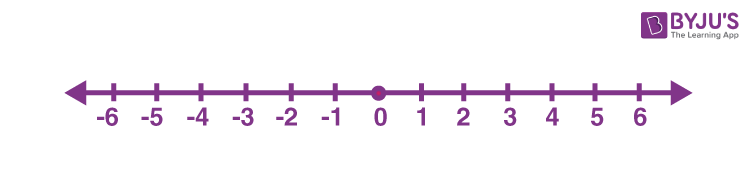
- The number on the right horizontal side is always greater than the left side number.
- Positive numbers are placed on the right side of 0, as they are greater than “0”.
- Negative numbers are placed on the left side of “0”, as they are smaller than “0”.
- Zero, which isn't positive or negative, is kept at the center.
- Addition of Integers
- Subtraction of Integer
- Multiplication of Integers
- Division of Integers
- Both integers have the same signs: Add the absolute values of integers, and give the same sign as that of the given integers to the result.
- One integer is positive and the other is negative: Find the difference of the absolute values of the numbers and then give the original sign of the larger of these numbers to the result.
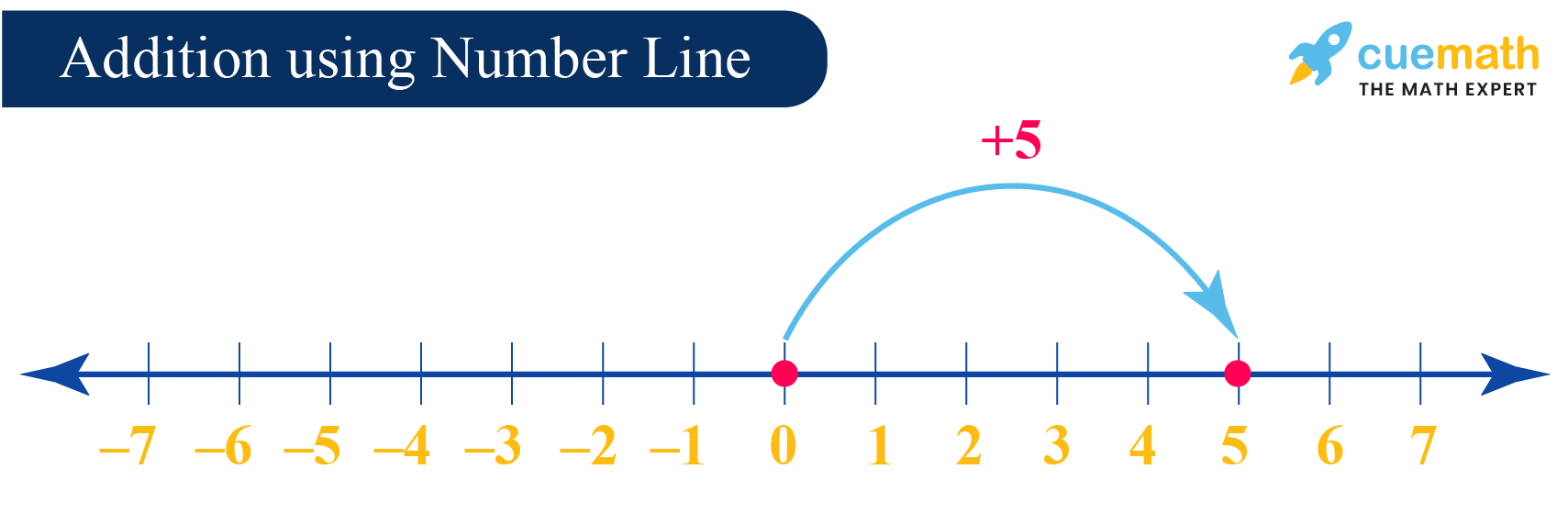
- always start from "0".
- move to the right side, if the number is positive.
- move to the left side, if the number is negative.

- Convert the operation into an addition problem by changing the sign of the subtrahend.
- Apply the same rules of addition of integers and solve the problem thus obtained in the above step.
Here, the absolute values of 7 and (-10) are 7 and 10 respectively.
Their difference (larger number - smaller number) is 10 - 7 = 3.
Now, among 7 and 10, 10 is the larger number and its original sign “-”.
Hence, the result gets a negative sign, "-”.
Therefore, 7 - 10 = -3
- Ascending order
- Descending order
Facts:
|
- 0 > – 8
- 8 > – 5
- 0 < 3
- -1 > -10
- 10 < 12
- -20 < 1
- -100 < -10
- 100 > -200


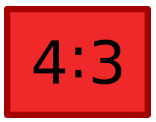
It reads as “4 is to 3”
It can also be written as 4/3.
Example
If there are 35 boys and 25 girls in a class, then what is the ratio of
Number of boys to total students
Number of girls to total students.
Solution
In the ratio, we want the total number of students.
Total number of students = Number of boys + Number of girls
35 + 25 = 60
Ratio of number of boys to total number of students
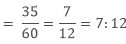
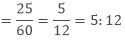
The ratio of the number of girls to the total number of students
The unit must be same to compare two quantities
If we have to compare two quantities with different units then we need to convert them in the same unit .then only they can be compared using ratio.
Example
What is the ratio of the height of Raman and Radha if the height of Raman is 175 cm and Radha is 1.35 m?
Solution
The unit of the height of Raman and Radha is not same so convert them in the same unit.
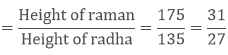
Height of Radha is 1.35 m = 1.35 × 100 cm = 135 cm
The ratio of the height of Raman and Radha
The Lowest form of the Ratio
If there is no common factor of numerator and denominator except one then it is the lowest form of the ratio.
Example
Find the lowest form of the ratio 25: 100.
Solution
The common factor of 25 and 100 is 25, so divide both the numerator and denominator with 25.
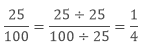
Hence the lowest ratio of 25: 100 is 1: 4.
Proportion
If we say that two ratios are equal then it is called Proportion.
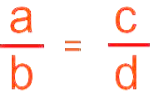
We write it as a: b : : c: d or a: b = c: d
And reads as “a is to b as c is to d”.
Example
If a man runs at a speed of 20 km in 2 hours then with the same speed would he be able to cross 40 km in 4 hours?
Solution
Here the ratio of the distances given is 20/40 = 1/2 = 1: 2
And the ratio of the time taken by them is also 2/4 = 1/2 = 1: 2
Hence the four numbers are in proportion.
We can write them in proportion as 20: 40 : : 2: 4
Extreme Terms and Middle Terms of Proportion
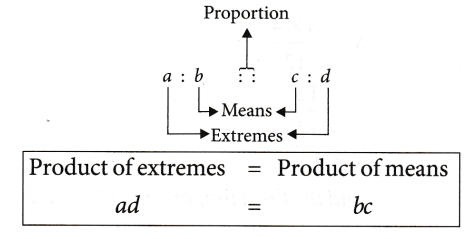
The first and the fourth term in the proportion are called extreme terms and the second and third terms are called the Middle or the Mean Terms.
In this statement of proportion, the four terms which we have written in order are called the Respective Terms.
If the two ratios are not equal then these are not in proportion.
Example 1
Check whether the terms 30,99,20,66 are in proportion or not.
Solution 1.1
To check the numbers are in proportion or not we have to equate the ratios.
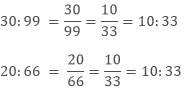
As both the ratios are equal so the four terms are in proportion.
30: 99 :: 20: 66
Unitary Method
If we find the value of one unit then calculate the value of the required number of units then this method is called the Unitary method.
Example 1
If the cost of 3 books is 320 Rs. then what will be the cost of 6 books?

Solution 1
Cost of 3 books = Rs. 320
Cost of 1 book = 320/3 Rs.
Cost of 6 books = (320/3) × 6 = 640 Rs.
Hence, the cost of 6 books is Rs. 640.

Roman numerals and the Hindu-Arabic numeral system are the two different types of number system used for writing numbers in many places. We all can see the roman numerals in clocks, page numbers, school timetable in syllabus page, etc.
Introduction
Introduction to numbers
- Numbers are arithmetic values.
- Numbers are used to convey the magnitude of everything around us.
Comparing numbers
Comparing numbers when the total number of digits is different
- The number with most number of digits is the largest number by magnitude and the number with least number of digits is the smallest number.
Example: Consider numbers: 22, 123, 9, 345, 3005. The largest number is 3005 (4 digits) and the smallest number is 9 (only 1 digit)
Comparing numbers when the total number of digits is same
- The number with highest leftmost digit is the largest number. If this digit also happens to be the same, we look at the next leftmost digit and so on.
Example: 340, 347, 560, 280, 265. The largest number is 560 (leftmost digit is 5) and the smallest number is 265 (on comparing 265 and 280, 6 is less than 8).
Ascending and Descending Order and Shifting Digits
Ascending order and Descending order
- Ascending Order: Arranging numbers from the smallest to the greatest.
- Descending Order: Arranging numbers from the greatest to the smallest number.
- Example: Consider a group of numbers: 32, 12, 90, 433, 9999 and 109020.
They can be arranged in descending order as 109020, 9999, 433, 90, 32 and 12, and in ascending order as 12, 32, 90, 433, 9999 and 109020.
How many numbers can be formed using a certain number of digits?
- If a certain number of digits are given, we can make different numbers having the same number of digits by interchanging positions of digits.
- Example: Consider 4 digits: 3, 0, 9, 6. Using these four digits,
(i) Largest number possible = 9630
(ii) Smallest number possible = 3069 (Since 4 digit number cannot have 0 as the leftmost number, as the number then will become a 3 digit number)
Shifting digits
- Changing the position of digits in a number, changes magnitude of the number.
- Example: Consider a number 789. If we swap the hundredths place digit with the digit at units place, we will get 987 which is greater than 789.
Similarly, if we exchange the tenths place with the units place, we get 798, which is greater than 789.
Place value
- Each place in a number, has a value of 10 times the place to its right.
- Example: Consider number 789.
(i) Place value of 7 = 700
(ii) Place value of 8 = 80
(iii) Place value of 9 = 9 Larger Numbers and Estimates
Introducing large numbers
Large numbers can be easily represented using the place value. It goes in the ascending order as shown below
8 digits
7 digits 6 digits 5 digits 4 digits 3 digits 10 million
(1 crore)
1 million (10 lakhs)
Hundred Thousands (1 lakh)
Ten Thousands Thousands Hundreds
- Largest 3 digit number + 1 = Smallest 4 digit number.
- Largest 4 digit number + 1 = Smallest 5 digit number, and so on.
Example: 9999 (greatest 4 digit number) + 1 = 10,000 (smallest 5 digit number) - We can convert every large numbers in terms of smaller numbers:
Remember, 1 hundred = 10 tens
1 thousand = 10 hundreds = 100 tens
1 lakh = 100 thousands = 1000 thousands
1 crore = 100 lakhs = 10,000 thousands
Estimation
- When there is a very large figure, we approximate that number to the nearest plausible value. This is called estimation.
- Estimating depends on the degree of accuracy required and how quickly the estimate is needed.
- Example:
Given Number Appropriate to Nearest Rounded Form 75847 Tens 75850 75847 Hundreds 75800 75847 Thousands 76000 75847 Tenth thousands 80000
Estimating sum or difference
- Estimations are used in adding and subtracting numbers.
- Example of estimation in addition: Estimate 7890 + 437.
Here 7890 > 437.
Therefore, round off to hundreds.
7890 is rounded off to 7900
437 is rounded off to + 400
Estimated Sum = 8300
Actual Sum = 8327 - Example of estimation in subtraction: Estimate 5678 – 1090.
Here 5678 > 1090.
Therefore, round off to thousands.
5678 is rounded off to 6000
1090 is rounded off to – 1000
Estimated Difference = 5000
Actual Difference = 4588
Estimating products of numbers
- Round off each factor to its greatest place, then multiply the rounded off factors.
- Estimating the product of 199 and 31:
199 is rounded off to 200
31 is rounded off to 30
Estimated Product = 200 × 30 = 6000
Actual Result = 199 × 31 = 6169
BODMAS
- We follow an order to carry out mathematical operations. It is called as BODMAS rule.
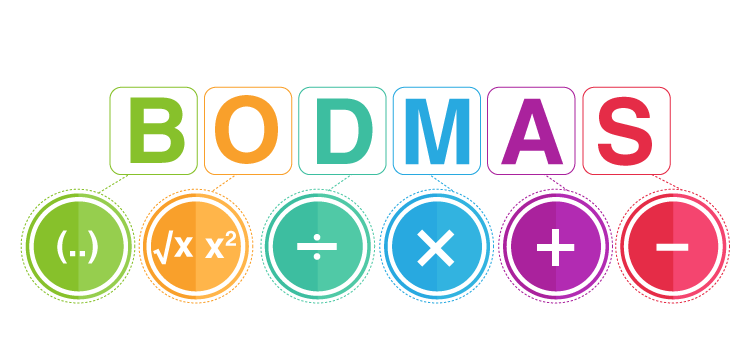
While solving mathematical expressions, parts inside a bracket are always done first, followed by of, then division, and so on.
- Example :
[(5 + 1) × 2] ÷ (2 × 3) + 2 – 2 = ?
[(5 + 1) × 2] ÷ (2 × 2) + 2 – 2….{Solve everything which is inside the brackets}
= [6 × 2] ÷ 6 + 2 – 2…..{Multiplication inside brackets}
= 12 ÷ 6 + 2 – 2……{Division}
= 2 + 2 – 2……{Addition}
= 4 – 2…….{Subtraction}
= 2
Using brackets
- Using brackets can simplify mathematical calculations.
- Example :
- 7 × 109 = 7 × (100 + 9) = 7 × 100 + 7 × 9 = 700 + 63 = 763
- 7 × 100 + 6 × 100 = 100 × (7 + 6) = 100 × 13 = 1300
- Introducing Large Numbers


 What is the Indian Numeral System?
The Indian numeral system contains numerals that are used to represent the numbers using a set of symbols. This system can be distinguished from the other numeral systems based on the nomenclature followed for different place values. When we use the Indian numeral system, we count with ones, tens, hundreds, thousands, ten thousands, lakhs, ten lakhs, and crores.
The following table depicts the different periods and places according to the number of digits in a number.

Use of Commas
According to the Indian numeral system, separators (comma) are used after every period while representing a number in its standard numeral form. For example, the number 384756182 can be better represented as 38,47,56,182 in the standard Indian numeral system form using separators after every period.
The number name for 38,47,56,182 is written as thirty-eight crore, forty-seven lakh fifty-six thousand, one hundred and eighty-two.
Place value and face value:
The place value of a digit of a number depends upon its position in the number. The face value of a digit of a number does not depend upon its position in the number. It always remains the same wherever it lies regardless of the place it occupies in the number.
Example: Let us see the place value and face value of the underlined digit in the number 1,32,460. The digit 2 in the number 1,32,460 lies in the thousands period (1000) and hence the place value of 2 is 2 thousands (or 2000). The face value of 2 is 2 only.
Expanded form:
When a number is written as the sum of the place values of all the digits of the number, then the number is in its expanded form.
Example: The expanded form of 9,67,480 is as shown below:
9,67,480 = 900000 + 60000 + 7000+400+80. International system of numeration
Values of the places in the International system of numeration are Ones, Tens, Hundreds, Thousands, Ten thousands, Hundred thousands, Millions, Ten millions and so on.
1 million = 1000 thousands,
1 billion = 1000 millions
Following place value chart can be used to identify the digit in any place in the International system.Periods
Billions
Millions
Thousands
Ones
Places
Hundreds
Tens
Ones
Hundreds
Tens
Ones
Hundreds
Tens
Ones
Hundreds
Tens
Ones
Commas in International system of Numeration
As per International numeration system, the first comma is placed after the hundreds place. Commas are then placed after every three digits.
e.g. (i) 8,876,547
The number can be read as eight million eight hundred seventy-six thousand five hundred and forty-seven.Roman Numerals
- Digits 09 in Roman are represented as : I, II, III, IV, V, VI, VII, VIII, IX, X
- Some other Roman numbers are : I = 1, V = 5 , X = 10 , L = 50 , C = 100 , D = 500 , M = 1000
Rules for writing Roman numerals
- If a symbol is repeated, its value is added as many times as it occurs.
Example: XX = 10 + 10 = 20 - A symbol is not repeated more than three times. But the symbols X, L and D are never repeated.
- If a symbol of smaller value is written to the right of a symbol of greater value, its value gets added to the value of greater symbol.
Example: VII = 5 + 2 = 7 - If a symbol of smaller value is written to the left of a symbol of greater value, its value is subtracted from the value of greater symbol.
Example: IX = 10 – 1 = 9. - Some examples : 105 = CV , 73 = LXXIII and 192 = 100 + 90 + 2 = C XC II = CXCII

There are so many branches of mathematics-
The study of numbers is called Arithmetic.
The study of shapes is called Geometry.
The study to use the letters and symbols in mathematics is called Algebra.
Algebra is a part of mathematics in which the letter and symbols are used to represent numbers in equations. It helps us to study about unknown quantities.
Matchstick Patterns

No. of matchsticks used to make 2nd square = 7
No. of matchsticks used to make 3rd square = 10
So, the pattern that we observe here is 3n + 1
With this pattern, we can easily find the number of matchsticks required in any number of squares.
Example
How many matchsticks will be used in the 50th figure?
Solution
3n + 1
3 × 50 + 1
= 151 matchsticks
The Idea of a Variable
Variable refers to the unknown quantities that can change or vary and are represented using the lowercase letter of the English alphabets.
One such example of the same is the rule that we used in the matchstick pattern
3n + 1
Here the value of n is unknown and it can vary from time to time.
More Examples of Variables
We can use any letter as a variable, but only lowercase English alphabets.
Numbers cannot be used for the variable as they have a fixed value.
They can also help in solving some other problems.
Example: 1
Karan wanted to buy story books from a bookstall. She wanted to buy 3 books for herself, 2 for her brother and 4 for 2 of her friends. Each book cost Rs.15.how much money she should pay to the shopkeeper?
Solution: 1
Cost of 1 book = Rs.15
We need to find the cost of 9 books.
| No. of notebooks | 1 | 2 | 3 | 4 | ……. | a | …..... |
| Total cost | 15 | 30 | 45 | 60 | …… | 15 a |
In the current situation, a (it’s a variable) stands for 9
Therefore,
Cost of 9 books = 15 × 9
= 135
Therefore Karan needs to pay Rs.135 to the shopkeeper of the bookstall.
The variable and constant not only multiply with each other but also can be added or subtracted, based on the situation.
If we use the equal sign between two expressions then they form an equation.
An equation satisfies only for a particular value of the variable.
The equal sign says that the LHS is equal to the RHS and the value of a variable which makes them equal is the only solution of that equation.
Example
3 + 2x = 13
5m – 7 = 3
p/6 = 18
If there is the greater then or less than sign instead of the equal sign then that statement is not an equation.
Some examples which are not an equation
23 + 6x > 8
6f – 3 < 24
Trial and Error Method
To find the solution of the equation, we use the trial and error method.
Example
Find the value of x in the equation 25 – x = 15.
Solution
Here we have to check for some values which we feel can be the solution by putting the value of the variable x and check for LHS = RHS.
Let’s take x = 5
25 – 5 = 15
20 ≠ 15
So x = 5 is not the solution of that equation.
Let’s take x = 10
25 – 10 = 15
15 = 15
LHS = RHS
Hence, x = 10 is the solution of that equation.


MUST WATCH FOR BETTER UNDERSTANDINGMain Teachings
Oral Explanation Online with some written work.
1. Factor of 6
1-> Since 1 exactly divides 6
2 -> Since it exactly divides 6
3 -> Since it exactly divides 6
6-> Since it exactly divides 6
2. every number is a factor of itself.
3. every factor of a number is an exact divisor of that number
4. every factor is less than or equal to the given number
5. number of factors of a given number are finite.
Example
Number is 6
Multiple will be
2. number of multiples of a given number is infinite
3. every number is a multiple of itself
1. 6
The factors of 6 are 1, 2, 3 and 6.
Now, .
2. 28
All the factors of 28 are 1, 2, 4, 7, 14 and 28.
Now, .
Example:
2, 3, 5, 7, 11 ,13
We can find list of prime numbers till 100 using Sieve of Eratosthenes method

Step 2: Encircle 2, cross out all the multiples of 2, other than 2 itself, i.e. 4, 6, 8 and so on.
Step 3: You will find that the next uncrossed number is 3. Encircle 3 and cross out all the multiples of 3, other than 3 itself.
Step 4: The next uncrossed number is 5. Encircle 5 and cross out all the multiples of 5 other than 5 itself.
Step 5: Continue this process till all the numbers in the list are either encircled or crossed out.
All the encircled numbers are prime numbers. All the crossed-out numbers, other than 1 are composite numbers
Example:
4, 6, 8 ,9….
Example
2,4,6,8,10,12,14
Even numbers have 0,2,4,6,8 in it one’s place.
Example
1,3, 5,7,9,11......
Important points about prime numbers based on definition of odd and even numbers
1. 2 is the smallest prime number which is even.
2. every prime number except 2 is odd.
|
Number |
Test of divisibility |
|
2 |
A
number is divisible by 2 if it has any of the digits 0, 2, 4, 6 or 8 in its
one’s place |
|
3 |
A
number is divisible by 3 if the sum of the digits is a multiple of 3, then
the number is divisible by 3. |
|
4 |
1)
For one and two-digit number, just check the divisibility by actual division. |
|
5 |
A
number is divisible by 5 if a number which has either 0 or 5 in its one’s
place |
|
6 |
A
number is divisible by 6 if a number is divisible by 2 and 3 both |
|
7 |
It
must be checked by actual division |
|
8 |
1)
For one, two-digit number, three-digit and four-digit number, just check the
divisibility by actual division |
|
9 |
A
number is divisible by 9, if the sum of the digits of a number |
|
10 |
A
number is divisible by 10 if a number has 0 in the ones |
|
11 |
A
number is divisible by 11 if the difference between the sum of the digits at
odd places (from the right) and the sum of the digits at even places (from
the right) of the number is either 0 or divisible by 11, |
So,
36 = 3×12 = 4 X 9
These form is called Factorisation
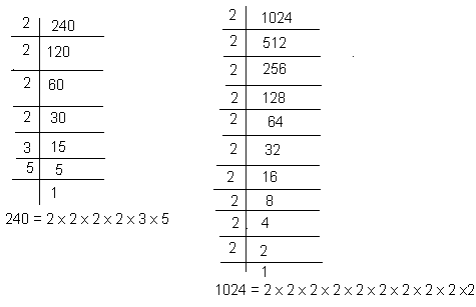
Prime Factorisation is expressing the number as a product of its prime factors
We can find prime factorisation by dividing the numbers with 2, 3, 5, 7 etc. in this order repeatedly so long as the quotient is divisible by that number
Steps to find HCF or GCD
a. Find the prime factorisation of the numbers
b. Choose the common factors in them
c. Multiply those common factors to obtain HCF.
(a) Find the HCF of 8 and 12
Prime Factorisation of the numbers
Common factors are 2,2
So
(b) Find the HCF of 20, 28 and 36
Prime Factorisation of the numbers
Common factors are 2,2
So
(b) The Lowest Common Multiple (LCM) of two or more given numbers is the lowest of their common multiples.
Steps to find LCM
(a) Find the prime factorisation of the numbers
(b) look for the maximum occurrence of all the prime factors in these numbers
(c) The LCM of the numbers will be the product of the prime factors counted the maximum number of times they occur in any of the numbers
(a) Find the LCM of 8 and 12
Prime Factorisation of the numbers
So,
Here we divide the given numbers by common prime number until the remainder is a prime number or one. LCM will be the product obtained by multiplying all divisors and remaining prime numbers.
Steps are
(1) We place number in the line
(2) We start dividing the number by least prime number which is common among all of them or group of them
(3) Keep dividing by least until we have 1's in the remainder
(4) LCM is the product of the divisors


What could be the least number which when we divide by 20, 25 and 30 leaves a remainder of 6 in every case?
Solution:
As we have to find the least number so we will calculate the LCM first.
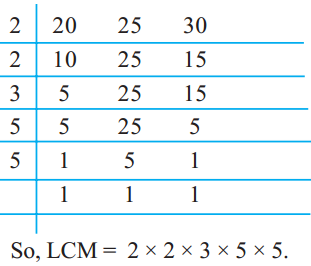
The required least number = 300 + 6 = 306.
ASSIGNMENTS

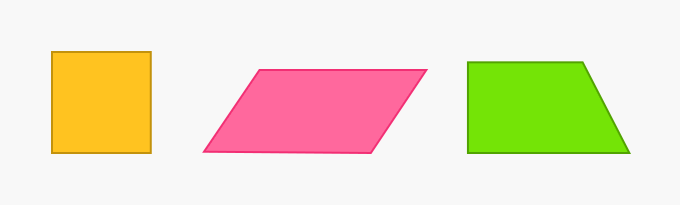
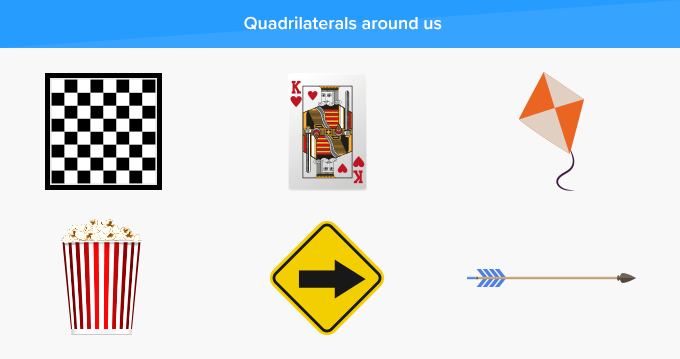
- A quadrilateral has 4 sides, 4 angles and 4 vertices.
- A quadrilateral can be regular or irregular.
- The sum of all the interior angles of a quadrilateral is 360°.
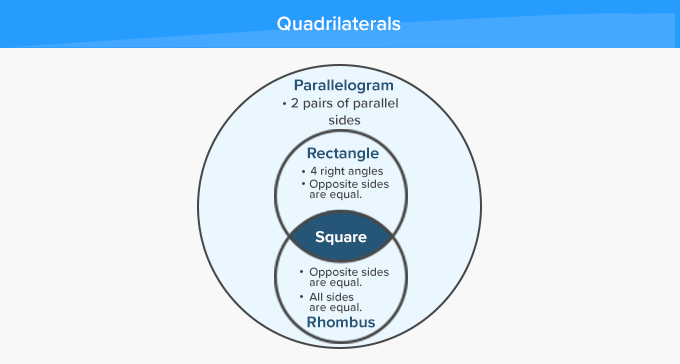
| Name of the Quadrilateral: | Picture of Quadrilateral: | Properties of the Quadrilateral: |
| Parallelogram |  | Opposite sides are parallel. Opposites sides are equal. Opposite angles are equal. |
| Square |  | All sides are equal. All angles are equal and measure 90°. |
| Rectangle |  | Opposite sides are parallel. Opposites sides are equal. All angles are equal and measure 90°. |
| Rhombus |  | All sides are equal. Opposite angles are equal. |
| Trapezoid |  | Opposite sides are parallel. Adjacent angles add up to 180°. |
Fun Facts
|
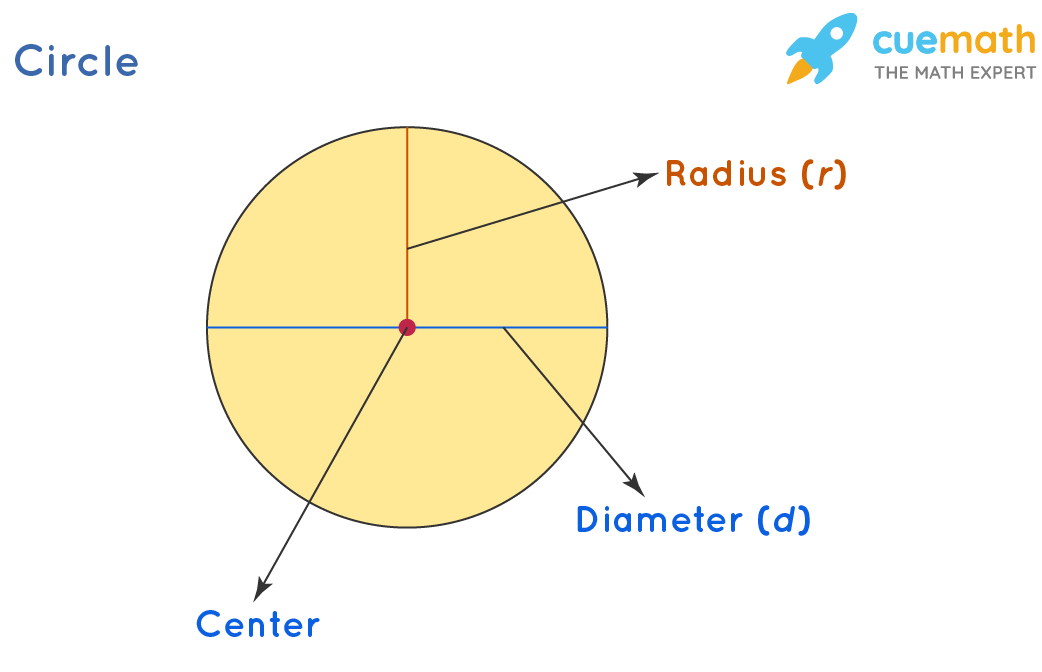
Radius of Circle: Radius is the distance from the center of a circle to any point on the boundary of the circle. A circle has many radii as it is the distance from the center and touch the boundary of the circle at various points
Diameter: A diameter is a straight line passing through the center that connects two points on the boundary of the circle. We should note that there can be multiple diameters in the circle, but they should:
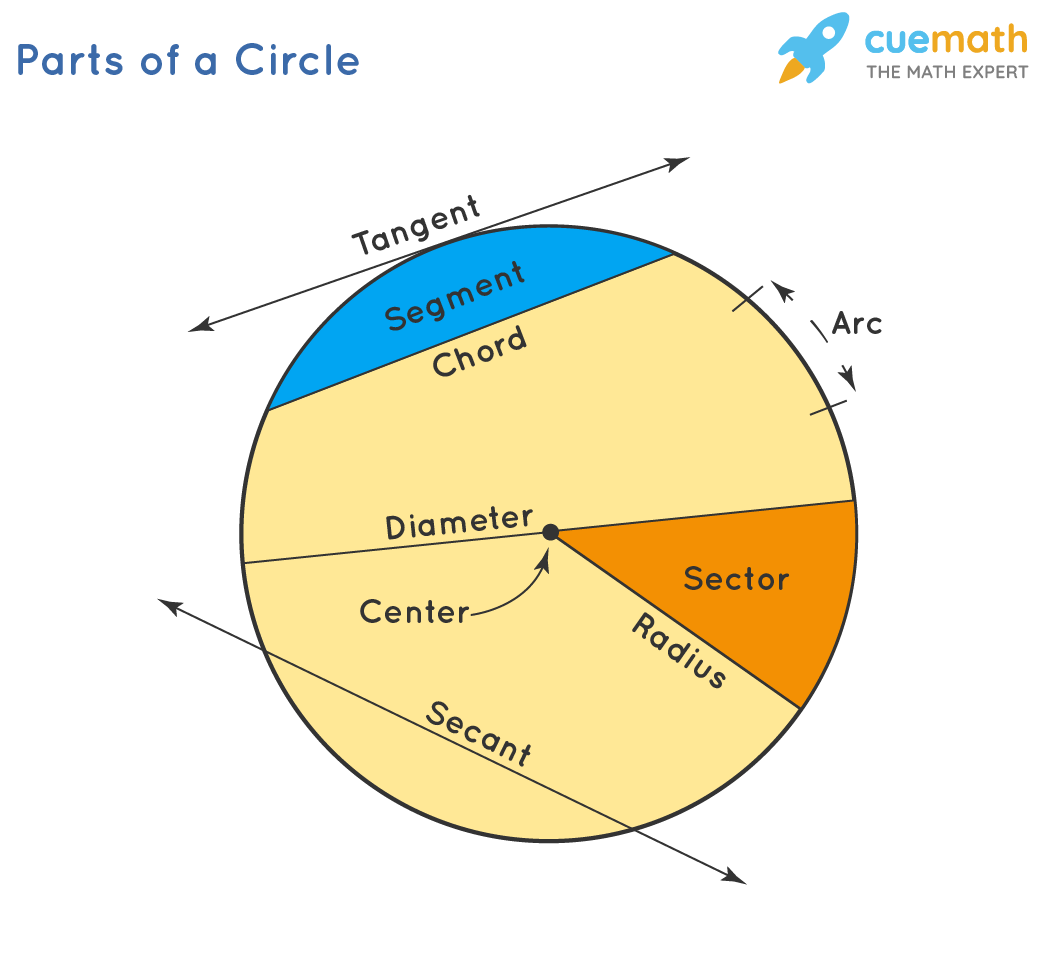
- pass through the center.
- be straight lines.
- touch the boundary of the circle at two points.
Tangent in Circle: A tangent of a circle is a line that touches the circle at a unique point.
Secant in circle: A line that intersects two points on an arc/circumference of a circle is called the secant.
Arc of a Circle: An arc of a circle is referred to as a curve, that is a part or portion of its circumference.
Segment in a Circle: The area enclosed by the chord and the corresponding arc in a circle is called a segment. There are two types of segments - minor segment, and major segment.
Sector of a Circle: The sector of a circle is defined as the area enclosed by two radii and the corresponding arc in a circle. There are two types of sectors, minor sector, and major sector.


- Area of a Circle Formula: The area of a circle refers to the amount of space covered by the circle. The area of a circle totally depends on the length of its radius. Area = π×r2
- Circumference of a Circle Formula: The circumference of a circle is the whole length of the circle(boundary). Circumference of circle = 2 × π × r.
- Open the compasses and measure a distance of 3.2 cm on the ruler. To do this one, metal end tip of the compass should be placed at zero and the pencil should be at 3.2 cms.

- Mark a point with a sharp pencil where we want the centre of the circle to be. Name it as O.
- Place the pointer ( metal tip) of the compasses on O. The width of the compass should not be altered.
- Turn the compasses slowly to draw the circle. Please see that the movement is completed around in one instant.





Ratio
Example
If there are 35 boys and 25 girls in a class, then what is the ratio of
Number of boys to total students
Number of girls to total students.
Solution
In the ratio, we want the total number of students.
Total number of students = Number of boys + Number of girls
35 + 25 = 60
Ratio of number of boys to total number of students
The ratio of the number of girls to the total number of students
The unit must be same to compare two quantities
If we have to compare two quantities with different units then we need to convert them in the same unit .then only they can be compared using ratio.
Example
What is the ratio of the height of Raman and Radha if the height of Raman is 175 cm and Radha is 1.35 m?
Solution
The unit of the height of Raman and Radha is not same so convert them in the same unit.
Height of Radha is 1.35 m = 1.35 × 100 cm = 135 cm
The ratio of the height of Raman and Radha
The Lowest form of the Ratio
If there is no common factor of numerator and denominator except one then it is the lowest form of the ratio.
Example
Find the lowest form of the ratio 25: 100.
Solution
The common factor of 25 and 100 is 25, so divide both the numerator and denominator with 25.
Hence the lowest ratio of 25: 100 is 1: 4.
Proportion
If we say that two ratios are equal then it is called Proportion.
We write it as a: b : : c: d or a: b = c: d
And reads as “a is to b as c is to d”.
Example
If a man runs at a speed of 20 km in 2 hours then with the same speed would he be able to cross 40 km in 4 hours?
Solution
Here the ratio of the distances given is 20/40 = 1/2 = 1: 2
And the ratio of the time taken by them is also 2/4 = 1/2 = 1: 2
Hence the four numbers are in proportion.
We can write them in proportion as 20: 40 : : 2: 4
And reads as “20 is to 40 as 2 is to 4”.
Extreme Terms and Middle Terms of Proportion
The first and the fourth term in the proportion are called extreme terms and the second and third terms are called the Middle or the Mean Terms.
In this statement of proportion, the four terms which we have written in order are called the Respective Terms.
If the two ratios are not equal then these are not in proportion.
Example 1
Check whether the terms 30,99,20,66 are in proportion or not.
Solution 1.1
To check the numbers are in proportion or not we have to equate the ratios.
As both the ratios are equal so the four terms are in proportion.
30: 99 :: 20: 66
Unitary Method
If we find the value of one unit then calculate the value of the required number of units then this method is called the Unitary method.
Example 1
If the cost of 3 books is 320 Rs. then what will be the cost of 6 books?
Solution 1
Cost of 3 books = Rs. 320
Cost of 1 book = 320/3 Rs.
Cost of 6 books = (320/3) × 6 = 640 Rs.
Hence, the cost of 6 books is Rs. 640.

~1. Introduction to Whole Numbers and Natural Numbers
~3. Understanding Order of Operations
~4. Explore the Number Patterns
Introduction to Whole Numbers and Natural Numbers
Performing Operations on Whole numbers like Addition, Subtraction, Multiplication and Division
Understanding Order of Operations
Explore the Number Patterns
Closure property:
E.g. 12 + 45 = 57
E.g 12 + 45 = 45 + 12
For any three whole numbers a, b and c, (a + b) + c = a + (b + c). , This means the sum is regardless of how grouping is done.
E.g 31 + (24 + 38) = (31 + 24) + 38
For every whole number a, a + 0 = a. Therefore ‘0’ is called the Additive identity.
E.g. 19 + 0 = 19
Closure property:
E.g. 150 – 100 = 50, is a whole number but 100 – 150 = -50 is not a whole number.
E.g 16 – 7 = 9 but 7 – 16 ≠ 9
For any three whole numbers a, b and c, (a – b) – c ≠ a – (b – c). Hence subtraction of whole numbers is not associative.
E.g. 25 – (10 – 4) = 25 – 6 = 19
(25 – 10) – 4 = 15 – 4 = 11
This means that 25 – (10 – 4) ≠ (25 – 10) – 4
For any two whole numbers a and b,their product ax b is always a whole number.
E.g. 12 x 7 = 84, 12, 7 and 84 all are whole numbers.
Commutative property:
For any two whole numbers a and b, a a x b = b x a Order of multiplication is not important.
E.g 11 x 6 = 66 and 6 x 11 = 66
Therefore, 11 x 6 = 6 x 11
For any three whole numbers a, b and c, (a x b) x c = a x (b x c), this means the product is regardless of how grouping is done.
E.g 8 x (4 x 5) = 8 x 20 = 160; (8 x 4) x 5 = 32 x 5 = 160
Therefore, 8 x (4 x 5) = (8 x 4) x 5
For any whole number a, a x 1 = a Since any number multiplied by 1 doesn’t change its identity hence 1 is called as multiplicative identity of a whole number. E.g. 21 x 1 = 21
For any whole number a, a x 0 = 0,
E.g 25 x 0 = 0
This property is used when we have to multiply a number by the sum.
For any three whole numbers a, band c a × (b + c) = a × b + a × c
In order to verify this property, we take any three whole numbers a, b and c and find the values of the expressions a × (b + c) and a × b + a × c as shown below:
Find 3 × (4 + 5).
In this case either you can add the numbers 4 and 5 and then multiply them by 3
3 × (4 + 5) = 3 × 9 = 27
OR you can multiply each addend by 3 and then add the products
3 × 4 + 3 × 5 = 12 + 15 = 27
Therefore, 3 × (4 + 5) = 3 × 4 + 3 × 5
For any two whole numbers a and b, a ÷ b is not always a whole number. Hence closure property is not applicable to division.
E.g. 68 and 5 are whole numbers but 68 ÷ 5 is not a whole number.
For any two whole numbers a and b, a ÷ b ≠ b ÷ a. This means division of whole number is not commutative.
E.g. 16 ÷ 4 ≠ 4 ÷ 16
Associative property:
For any 3 whole numbers a, b and c,(a ÷ b) ÷ c ≠ a ÷ (b ÷ c)
80 ÷ (10 ÷2) = 80 ÷ 5 = 16
(80 ÷ 10) ÷ 2 ≠80 ÷ (10 ÷2)
Hence division does not follow associative property.
For any whole number a, a ÷ 1 = a, this means any whole number divided by 1 gives the quotient as the number itself.
E.g. 14 ÷ 1 = 14; 26 ÷ 1 = 26
Division of 0 by any whole number
For any whole number, a ≠ 0, 0 ÷ a = 0, this shows zero divided by any whole number (other than zero) gives the quotient as zero.
E.g. 0 ÷ 1 = 0; 0 ÷ 25 = 0;
To divide any number, say 7 by 0, we first have to find out a whole number which when multiplied by 0 gives us 7. This is not possible. Therefore, division by 0 is not defined.
Patterns in whole numberA pattern is a sequence of numbers or picture.
Number Patterns
The order of Operations is the rule in math that states we evaluate the parentheses/brackets first, the exponents/the orders second, division or multiplication third (from left to right, whichever comes first), and the addition or subtraction at the last (from left to right, whichever comes first).
Number Patterns
The order of Operations is the rule in math that states we evaluate the parentheses/brackets first, the exponents/the orders second, division or multiplication third (from left to right, whichever comes first), and the addition or subtraction at the last (from left to right, whichever comes first).
Do Exercise ( 2A, 2B, 2C, 2D, 2E ) , Mental Maths, Multiple Choice Questions and Chapter Test page nos 51-52.


Brackets help in simplifying an expression that has more than one mathematical operation.
If an expression that includes the brackets is given, then perform the operation inside the bracket and change every thing into a single number. Then carry out the operation that lies outside the bracket.
e.g.
1. (6 + 8) x 10 = 14 x 10 = 140
2. (8 + 3) (9 - 4) = 11 x 5 = 55
International system of numeration
Values of the places in the International system of numeration are Ones, Tens, Hundreds, Thousands, Ten thousands, Hundred thousands, Millions, Ten millions and so on.
1 million = 1000 thousands,
1 billion = 1000 millions
|
Periods |
Billions |
Millions |
Thousands |
Ones |
||||||||
|
Places |
Hundreds |
Tens |
Ones |
Hundreds |
Tens |
Ones |
Hundreds |
Tens |
Ones |
Hundreds |
Tens |
Ones |
The number can be read as eight million eight hundred seventy-six thousand five hundred and forty-seven.
The number system invented by Romans is called Roman number system or Roman Numerals.
|
Symbol |
Value |
Repitition Allowed |
|
I |
1 |
Yes (3 times at max) |
|
V |
5 |
No |
|
X |
10 |
Yes (3 times at max) |
|
L |
50 |
No |
|
C |
100 |
Yes (3 times at max) |
|
D |
500 |
No |
|
M |
1000 |
Yes (3 times at max) |
If a symbol is repeated, its value is added as many times as it occurs. Examples,Rules for writing Roman Numerals:
- II = 2
- CCC = 300
- A symbol is not repeated more than three times. But the symbols V, L and D are never repeated. Example,
- XX is correct but DD is not.
- If a symbol of smaller value is written to the right of a symbol of greater value, its value gets added to the value of greater symbol. Example,
- XI = 11
- VII = 7
- If a symbol of smaller value is written to the left of a symbol of greater value, its value is subtracted from the value of the greater symbol. Example,
- IX = 9
- XC = 90
- The symbols V, L and D are never written to the left of a symbol of greater value, i.e. V, L and D are never subtracted. The symbol I can be subtracted from V and X only. The symbol X can be subtracted from L, M and C only.
73 = 70 + 3
70 = 50 + 10 + 10 = LXX
3 = 1 + 1 + 1 = III
Hence 73 can be written as LXXIII
(b) 92
92 = 90 + 2
90 = 100 - 10 = XC
2 = 1 + 1 = II
Hence 92 can be written as XCII
1) If two numbers have unequal number of digits, then the number with the greater number of digits is greater.
2) If two numbers have equal number of digits then, the number with greater valued digit on the extreme left is greater. If the digits on extreme left of the numbers are equal then the digits to the right of the extreme left digits are compared and so on.
a) Comparison between 358 and 4567
Answer
Here 4567 has four digits and 358 has three digits, so clearly 4657 is greater than 358
b) Comparison between 1345 and 2456
Answer
Here both the number have same digit, So we need start looking at the extreme left digit
1345 -> 1
2456 -> 2
Now 2 > 1
So we can clearly state 2456 > 1345


Extension To Large Numbers
Extending the concepts of Place value, Expanded Form and Comparison of Numbers to Large Numbers
Extension To Large Numbers
Extending the concepts of Place value, Expanded Form and Comparison of Numbers to Large Numbers
Video-1 Introducing Large Numbers
Introducing Large NumbersWhat is the Indian Numeral System?The Indian numeral system contains numerals that are used to represent the numbers using a set of symbols. This system can be distinguished from the other numeral systems based on the nomenclature followed for different place values. When we use the Indian numeral system, we count with ones, tens, hundreds, thousands, ten thousands, lakhs, ten lakhs, and crores.The following table depicts the different periods and places according to the number of digits in a number.Use of CommasAccording to the Indian numeral system, separators (comma) are used after every period while representing a number in its standard numeral form. For example, the number 384756182 can be better represented as 38,47,56,182 in the standard Indian numeral system form using separators after every period.The number name for 38,47,56,182 is written as thirty-eight crore, forty-seven lakh fifty-six thousand, one hundred and eighty-two.Place value and face value:The place value of a digit of a number depends upon its position in the number. The face value of a digit of a number does not depend upon its position in the number. It always remains the same wherever it lies regardless of the place it occupies in the number.Example: Let us see the place value and face value of the underlined digit in the number 1,32,460. The digit 2 in the number 1,32,460 lies in the thousands period (1000) and hence the place value of 2 is 2 thousands (or 2000). The face value of 2 is 2 only.Expanded form:When a number is written as the sum of the place values of all the digits of the number, then the number is in its expanded form.Example: The expanded form of 9,67,480 is as shown below:9,67,480 = 900000 + 60000 + 7000+400+80.
Do Exercises-1G and 1H full.
We know, while arranging numbers from the smallest number to the largest number, then the numbers are arranged in ascending order.
Suppose for example, 81, 97, 123, 137 and 201 are arranged in ascending order.
Vice-versa while arranging numbers from the largest number to the smallest number then the numbers are arranged in descending order.
Suppose for example, 187, 121, 117, 103 and 99 are arranged in descending order.


