Tuesday, June 22, 2021

6 SCIENCE 2021-2022

 R/15                                                          
 20/09/2021, 21/09/2021 
CHAPTER- 06 A STUDY OF CHANGES
SCIENCE

Topics to be covered...
~Introduction

~Reversible changes

~Irreversible changes

~Physical change

~Chemical change


MAIN TEACHING :-
Oral and Explanation Online with some written work and slides.

Introduction
Everything around us is undergoing a process of change. Our hair and nails keep growing. Leaves die and new leaves take their place. While some changes in our environment are temporary and can change back to their original positions, other changes are relatively permanent.

On this basis, changes around us can be classified into two broad categories:
1. Reversible changes
2. Irreversible changes
Reversible changes can be described as changes that can be reversed by reversing the action or changing the conditions. Example: freezing of water, rolling of a chapati from dough etc.
Irreversible changes can be described as changes that cannot be reversed even after bringing about changes in the conditions. Example: rusting of iron, cooking of vegetables etc.
Figure 1 Closing and opening of mimosa leaves represent a reversible change
Figure 2 Cooking of an egg into an omelette represents an irreversible change
Substances and materials usually undergo two major types of changes:
  • Physical change: This represents a change not in the chemical identity but the physical form of a substance. When substances undergo a physical change, there is no formation of a new substance and more or less these changes can be reversed. Example: boiling of water and melting of ice represent reversible physical changes while growing of height is an irreversible physical change.

Figure 3 Physical Change
  • Chemical change: This represents a change in the chemical identity of a substance. These are irreversible changes because the original substance gets converted into a new substance and cannot be brought back. Example: cooking of rice, burning of matchstick etc.

Figure 4 Chemical Change
Difference between physical and chemical changes:
Physical ChangeChemical Change

A change in matter which occurs without causing any change in the composition of the matter is known as physical change

While a chemical change is defined as the change in the chemical composition of matter

Usually, physical changes are reversible in nature

While chemical changes are often irreversible

No new products are formed when an object undergoes physical change

Chemical changes often lead to formation of new products

These changes have no impact on the molecular composition of the substance

Chemical changes have a direct impact on the chemical bonds and molecular composition of a substance

A few changes occur when cooling or heating is done

These changes involve absorption or release of energy

There are other ways to bring about changes in substances:

  • Mixing two substances together: A small amount of curd is added to warm milk which leads to conversion of that milk into curd. This is an irreversible change.

When we add a salt to water it becomes salty but this is a reversible change.

  • Expansion and Contraction: In order to make tools like an axe, the ring of its iron blade is heated which allows it to expand i.e. become larger in size and then is allowed to cool down which makes it contract again i.e. become smaller in size leading to a tight fit of the handle.

Figure 5 Curd is added to milk to allow it to set into curdFigure 5 Curd is added to milk to allow it to set into curd
NOW WATCH THE VIDEOS
ASSIGNMENTS
Complete all the questions given below in your OCB (Online Classes Ex-books) 
A. Choose the correct option in the following.
Question 1.
Which of the following changes can be reversed?
(a) Raw egg to boiled egg
(b) Wet clothes to dry clothes
(c) Bud to flower
(d) Cow dung to biogas

Question 2.
Which of the following changes cannot be reversed?
(a) Milk to paneer
(b) Cold milk to hot milk
(c) Yam to knitted sweater
(d) Wet clothes to dry clothes

Question 3.
Metal rim is fixed to the wooden cart wheel by
(a) heating metal rim
(b) heating wooden wheel
(c) cooling metal rim
(d) cooling wooden wheel

Question 4.
On heating metal rim
(a) expands
(b) contracts
(c) depends how much it is heated
(d) depends as the type of meted

Question 5.
Which one of the steps while burning a candle is not reversible?
(a) Melting of solid wax
(b) liquid wax changes into vapours
(c) Wax vapour bums into flame
(d) All of these

Question 6.
Which is a way to make a change happen?
(a) Heating a substance
(b) Cooling a substance
(c) Mixing a substance with another substance
(d) All of these

Question 7.
Rusting of iron is an example of
(a) slow change
(b) fast change
(c) reversible change
(d) physical change

Question 8.
Conversion of a solid to liquid by heating is called
(a) evaporation
(b) melting
(c) condensation
(d) freezing

Question 9.
Which of the following is not a man-made change?
(a) Change of day and night
(b) Burning of fuels
(c) Drying of clothes
(d) Tearing of paper

Question 10.
Which of the following is a chemical change?
(a) Evaporation of water
(b) Burning of fuels
(c) Moving of a wheel
(d) Breaking of a brick

 R/14                                                          
 06/09/2021, 07/09/2021, 13/09/2021, 14/09/2021 
 CHAPTER- 05 Separation of Mixtures 
 SCIENCE 

 Topics to be covered... 
~Introduction
~What is separation
~Method of separation
~Handpicking
~Threshing
~Winnowing
~Seiving
 MAIN TEACHING :- 
Oral and Explanation Online with some written work and slides.
Introduction
On a day-to-day basis, we are faced with various instances when we are required to separate substances from one another. Whether it is picking out chillies from our paranthas/poha or separating tea leaves from tea while serving it, the need for separation of substances is something we encounter on a daily basis. It is usually because of one or all three of the following reasons:
  • To separate two dissimilar but useful elements like in the case of butter and milk. Milk is churned in order to obtain butter.

  • To segregate useless elements from the useful ones like in the case of separating tea leaves from tea.

  • To remove and discard impurities or potentially harmful substances like picking out small pieces of stones and other impurities from rice and wheat.

Figure 1 Separating tea leaves from tea

Figure 1 Separating tea leaves from tea

Problems arise when the materials to be separated are really small in size or differ in their composition. It is nearly impossible to separate grains of salt from grains of sand by hand or trying to separate oil from water. We might need to use methods other than simple handpicking even though for a lot of separation processes, even handpicking might be enough.
Methods of Separation
Figure 2 Methods of Separation
  • HandpickingThe simple process of separating slightly bigger sized harmful substances or other useful substances or impurities like small pieces of stones, husk and dirt from grains of wheat, pulses and rice is called handpicking. In situations when the quantity of such impurities is not very large, handpicking turns out to be a time-saving and convenient procedure of separating substances.

Figure 3 A group of individuals separating two types of grains
Threshing: After the crop is harvested, stalks are left to dry under the sun. A single stalk has some 100 pieces of grain seeds joined to it. It is manually impossible to pluck each grain seed which is very small in size from the stalk and hence handpicking as a method of separation does not work here. That is why we use a method called threshing to separate these grain seeds.
  • Thus, Threshing can be defined as the process of separating the edible part i.e. grain seeds from the stalk by either with the help of machines, bullocks or sometimes by beating them.

4 a) Threshing by machine
Figure 4 b) Threshing by hand
Winowing: Even when threshing is done, husk or chaff is still attached to the grain seed and since the size of the two is quite similar, handpicking does not work and neither does threshing. Hence, a method called winnowing can be used.
  • Winnowing can be defined as the method of separating lighter husk particles and heavier grain seed components by blowing a current of air through them. The lighter husk particles are carried away by the wind and the grain seeds get separated. This husk can be further used as fodder for the cattle.

Figure 5 Process of winnowing
  • Sieving: Sometimes even after the grain seeds have passed through the stages of threshing and winnowing, husk may still be attached to the grain or it may have collected stones and dirt in the earlier stages which need to be removed and this separation is usually done with the help of a sieve.

    • Sieving is a very simple, convenient and time-saving process through which particles of varying sizes can be separated from each other with the help of a sieve. A sieve is nothing but a simple device with small pores in it which allow finer materials like flour to pass through leaving behind any impurities it might contain.

Figure 6 Sieving
Figure 6 Sieving
  • Sedimentation, Decantation and Filtration

    1. Sedimentation: Sedimentation can be defined as the process through which dirt and other heavier particles in a mixture settle at the bottom of the vessel when water is added to it. When the dust and dirt particles have settled, the clear water which forms the upper layer is moved to a different container and the dirt and dust is done away with. This technique can also be used to separate two liquids which do not mix with each other (also called immiscible liquids) and is called decantation.

    2. Decantation: Decantation can be defined as a technique through which immiscible liquids or a liquid and a solid substance are separated. For example, take the case of oil and water. These are two examples of immiscible liquids. Once we pour oil in water, oil forms the upper layer of water and can be easily separated by gently pouring the mixture in another container till all the oil has been removed. Sometimes smaller dirt particles get carried along with the water in the process of decantation which needs to be further removed. This can be achieved through the process of filtration.

    3. Filtration: Filtration is the process through which smaller particles like dirt etc. are separated from a solution by making the solution pass through a medium (often a filter paper). This medium is such that only liquids are able to pass through it because of the presence of very tiny pores in it. The filter paper is molded to form a cone and this cone-like structure is then affixed to a funnel through which the dirty solution is allowed to pass. Sometimes, filtration can also be applied to separate pulp and seeds from the juice. It can also be used to separate cottage cheese or paneer from milk.

Figure 7 Sedimentation, Decantation and Filtration
  • Evaporation: Evaporation is the process of converting liquid into gas or vapour by increasing the temperature or pressure of the liquid. This process is often used to separate salt from salt water or salty sea water. Sea water has a number of salts present in it. Shallow pits called evaporation ponds are constructed and salt water is allowed to stand in these. After some time, the water gets evaporated, leaving behind the salts. Common salt is separated from this mixture upon further purification.

Figure 8 Salt Evaporation Ponds
Use of more than one method of separation

Often, we are faced with mixtures and solutions that cannot be separated by use of a single separation technique. A number of such techniques need to be applied simultaneously to achieve the desired result.

Take for example the case of a salt and sand mixture. We know handpicking will not work and considering both of them weigh just about the same, neither will winnowing.

And hence we try to separate the two with the help of filtration or decantation.

We take a beaker and add water to the said mixture of salt and sand. While the salt dissolves in water, the sand deposits at the bottom of the beaker and can be separated from the salt solution with the help of a filter paper or by gently pouring the salt solution in another container. We now have to separate the salt from water, for which we will simultaneously use the methods of evaporation and condensation. While heating the solution in a kettle, we observe that vapour or steam starts to rise from the spout of the kettle. What we then do is allow this steam to come in contact with a metal plate which has some ice on it. When this happens, the steam gets converted to small drops of water which we transfer to another container and thus successfully manage to separate salt which gets left behind in the kettle and the water which we collect in a separate container.

Condensation is the defined as the simple process of converting gas or vapour to its liquid form by decreasing the temperature or pressure exerted on it. This is what we did when we allowed the steam to come in contact with the cold metal plate.
Figure 9 Use of more than one method of separation
Can Water Dissolve Any Amount of a Substance?

Even though water can dissolve a number of substances and solutions in it, it has a limit to how much it can dissolve. After a certain point, it stops dissolving any more of that substance and the substance collects at the bottom of the vessel. We say that the solution has become saturated.

A saturated solution is one that contains the maximum possible concentration of a particular solute. For example, if we continue to add increasing amounts of salt to a small quantity of water, there will come a point that the salt will not get mixed with the water and instead deposit at the bottom. At this point, we say that the solution has become saturated i.e. it is now incapable of dissolving any more of the given solute which is in this case, salt.

A salute is defined as a very small element in a solution that is dissolved in a solution.

One way of ensuring that the given amount of water takes more salt even after it has reached its saturation point is by heating the said water. This is because heating the solution helps to increase the solubility of salt or any solute and hence more amount of the same solute can now be dissolved in the same amount of water.

Some Important Definitions

Churning: The process of shaking milk or cream in order to allow lighter particles to come to the surface in order to make butter is called churning.

Pure Substance: This can be defined as a substance composed of only a single type of particle.

Impure Substance: A substance composed of more than one type of particles.

Sublimation: When a solid directly gets converted into vapour, this process is known as sublimation.

Magnetic Separation: This is another method of separation which allows metals (and other articles which are attracted to a magnet) to be separated from a mixture with the help of a magnetic or by applying a magnetic force to it. For example, a mixture of salt and iron filings can be separated with the help of a magnet.

NOW WATCH THE VIDEOS


 Complete all the questions given below in your OCB (Online Classes Ex-books) 


 R/13                                                          
 23/08/2021, 24/08/2021, 31/08/2021 
 CHAPTER- 11 MEASUREMENT 
SCIENCE
 Topics to be covered... 
~Introduction
~Arbitrary ways to measure the length or width
~Standard Units of Measurement
~Correct Way to Use a Meter Scale
~Measurement Along Curved Line

 MAIN TEACHING :- 
Oral and Explanation Online with some written work and slides.
Introduction
With the changing times, transport also has gone through various modifications i.e. from animals to the invention of wheels. The evolution of transport is evident when we observe the fast cars, bullet trains etc. Even today new modes of transport are being researched upon.

Shows the advancement in transport

Fig 1: Shows the advancement in transport

  • Distance: How far an object travels constitutes distance!! The GPS system introduced these days accurately measures the distance from one place to another.

  • Arbitrary ways to measure the length or width:

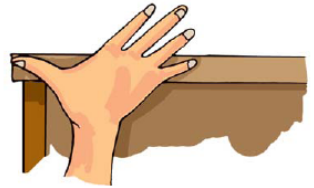
  • Measuring using handspan and measurement by a string were used in ancient times but these methods are not so reliable and hence some standard units of measurement have been introduced.

The Handspan Method

Fig 2: The Handspan Method

Standard Units of Measurement

Earlier the ‘cubit’ was accepted as a standard unit in Egypt. A cubit meant the length between fingertips and elbow. Owing to the differences in the length of body parts of each person these arbitrary systems became obsolete. Other units used earlier were ‘foot’, end of outstretched arm and chin, fist, etc.
Nowadays, the International System of units or the SI units have been accepted all over the world as a standard unit of measurement.
1 m = 100 cm
1 kg = 1000 g
1s = 1/60 min
The MKS system i.e. the metre-kilogram-second system is called the SI System.

Standard units
Different standard units of measurement were created at different places. For the sake of uniformity, scientists all over the world have accepted a set of standard units of measurements. This standard system of unit is known as the International

System of Units i.e SI Units.
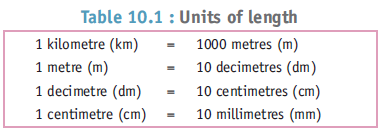
The SI unit for length is metre. Sometimes you need to measure very long lengths and sometimes very short ones. Therefore, depending upon the need, different simple multiples and sub-multiples of unit of length, i.e., metre are used. The length or breadth of a room is measured in metres. The distance between two places, i.e., towns and cities is measured in kilometres. The length of a notebook is measured in centimetres. The thickness of a wire is measured in millimetres.  The relation between these simple multiples and sub-multiples is shown in Table 10.1.
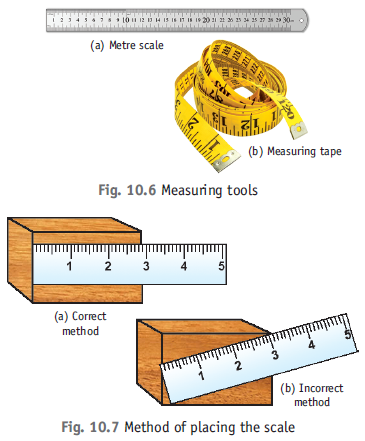
The measurement of length using standard unit of measurement, i.e., metre is made using various measuring tools. Commonly used measuring tools for length are metre scale or metre rulermetre rod and measuring tape.

You keep a 15 cm scale in your geometry box. A cloth merchant uses a metre rod for measuring the length of the cloth. A tailor uses a measuring tape to take measurements for stitching your clothes. (Fig. 10.6)
For taking measurement of a length, the following steps are followed :
(i) Place the metre scale along the length to be measured, parallel to its graduation (the markings on a scale), as shown in Fig. 10.7
(ii) Make sure that its zero mark coincides with one of the ends of the length to be measured.
(iii) In some scales, the ends may be broken and you may not be able to see the zero mark clearly. In such cases, some other digit say mark 1 can be taken as initial reading. You must remember the digit taken and subtract it from the final reading at the other end to get an accurate measurement of the length.
For example, in Fig. 10.8 the initial reading is 1 cm and the final reading is 6 cm. Therefore, the length of the box is 6 cm – 1 cm = 5 cm.
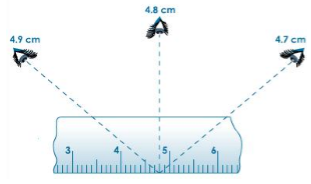
(iv) For taking measurements, correct position of the eye is also very important. The eye must be placed exactly vertically above the mark to be read. Fig. 10.9.
Correct Way to Use a Meter Scale
Step 1: Keep the scale in contact with the object to be measured.
Step 2: Start measuring from the 0 mark of the scale.
Step 3: To avoid taking incorrect measurements the eye position should be correct. Consider the following figure:
The eye position in the centre is correct to get an accurate measurement, while the ones in the left and right direction will give some error in measurement.
The eye position in the centre is correct to get an accurate measurement, whiight direction will give some error in measurement.
Measurement Along Curved Line
Is it possible to measure a curved line with a metre scale? Well, it is not so. Hence to measure a curved line the following steps can be taken into account:
  • Take a thread and tie a knot at one end.

  • From this end measure a small portion of the curved line which is somewhat straight and put the thumb.

  • Now again start from the thumb marked position and measure another small portion of the line.

  • Repeat this process until you reach the end of the line. Tie a knot on the thread on reaching the end. Now measure the two knots using a metre scale.

Measuring A Curved Line
Fig 4: Measuring A Curved Line
NOW WATCH THE VIDEOS
 Complete all the questions given below in your OCB (Online Classes Ex-books) 
A. Answer the following in not more than 20 words:-
1.What is a standard unit?
2. What are the SI unit of mass, length and time?
3. Why is it advisable to take an average of three readings while making scientific measurements?
4. What discovery made by Galileo help in  the invention of the pendulum clock?
5. Earlier, pepole used parts of the body to measure length .why is this not an accurate way of making measurements?
6. What is a beam balance?
7. What is a pendulum?
8. What were the units of time given by the Babylonians?

B. Answer the following in not more than 40 words:-
1. What three points must you keep in mind while measuring a length with a ruler?
2. Why did people feel the need to measure length?
3. How will you measure length using a broken ruler?

 R/12                                                          
 10/08/2021 
 SCIENCE 
 CHAPTER- 12 MOTION 
 REVISION 
 Topics to be covered...
~Introduction
~Motion 
~Types of motion

 MAIN TEACHING :-
Oral and Explanation Online with some written work and slides.
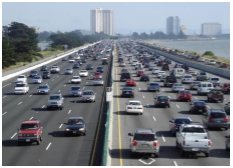
Motion
On the other hand, men, women, animals, birds, car, bus, bicycle, train, aeroplane, ship etc. do not remain stationary all the time, they can move from one place to another. The movement of an object is called motion.

A common characteristics of all the moving bodies is that they change their position with time. An object is said to be in motion (or moving) when its position changes with time.
For example: When the position of a car changes with time, we say that the car is moving or that car is in motion.

Types of Motion 
NOW WATCH THE VIDEOS
 Complete all the questions given below in your OCB (Online Class Ex-books) 
A. Choose the correct option in the following 
Question 1.
Which is a standard unit of measurement?
(a) Angul (finger)
(b) Mutthi (fist)
(c) Step
(d) Inch

Question 2.
What is the SI unit of length?
(a) Metre
(b) Centimetre
(c) Kilometre
(d) All of these

Question 3.
4 kilometres are equal to
(a) 4,00,000 metre
(b) 40,000 metre
(c) 4,000 metre
(d) 400 metre

Question 4.
15 cm are equal to
(a) 150 mm
(b) 15 mm
(c) 1.5 mm
(d) 0.15 mm

Question 5.
Which is a correct relationship?
(a) 1 m = 100 cm
(b) 1 cm = 100 mm
(c) 1 km = 100 m
(d) all of these

Question 6.
Each metre is decided into 100 equal divisions, called ……………. .
(a) Metre
(b) Centimetre
(c) Kilometre
(d) kilogram

Question 7.
An example of rectilinear motion is
(a) apple falling from a tree
(b) motion of a car on road
(c) a spinning top
(d) both (a) and (b)

Question 8.
Which is an example of a periodic motion?
(a) Oscillation of a pendulum
(b) Motion of a bus on road
(c) A spinning top
(d) A stone dropped from a certain height

Question 9.
What kind of motion is executed by a pendulum of a wall clock?
(a) Oscillatory motion
(b) Vibratory motion
(c) Circular motion
(d) Linear motion

Question 10.
One metre is equal to ………….. millimetre.
(a) 10
(b) 1000
(c) 100
(d) 10000

 R/11                                                          
 04/08/2021, 09/08/2021 
 SCIENCE 
 CHAPTER- 7 THE LIVING AND THE NON - LIVING 
 REVISION 
 Topics to be covered... 
~Introduction
~Characteristics Of Living And Non Living Things
~Difference between Living and Non-living things

 MAIN TEACHING :- 
Oral and Explanation Online with some written work and slides.

Characteristics Of Living And Non Living Things
We can find many things around us, from mountains and oceans to plants and animals. The earth in which we live is made up of several things.  These “things” can be categorized into two different types – Living and Non-living Things.
  • All living things breathe, eat, grow, move, reproduce and have senses.
  • Non-living things do not eat, grow, breathe, move and reproduce. They do not have senses.
Living things have “life,” though some might not show its evident signs. For instance, a tree would probably not react the same way a human would. It would not react when we hit it, and it might not be able to walk around. Though the signs of life displayed by them are not very observable, it does not make them non-living.
Let us have a detailed look at the important characteristics of living and non-living things and the difference between the two.
Living things exist and are alive and are made of microscopic structures called cells. They grow and exhibit movement or locomotion. They experience metabolism, which includes anabolic and catabolic reactions.
Living things are capable of producing a new life which is of their own kind through the process of reproduction. Living things have a particular life span and are not immortal.
Living things
Cellular Respiration enables living organisms to acquire energy which is used by cells to perform their functions. They digest food for energy and also excrete waste from the body. Their life cycle can be summarised as follows – birth, growth, reproduction and death.
Examples of living things are animals, birds, insects, human beings.
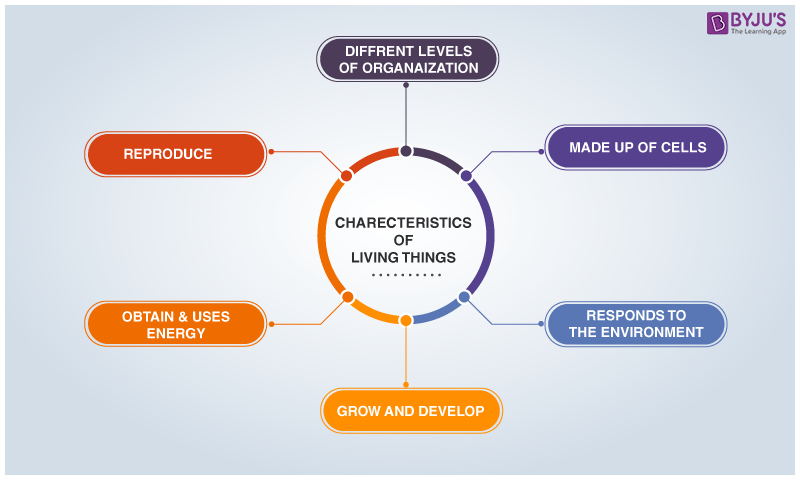
Characteristics of Living Things
Characteristics Of Living And Non Living Things
Characteristics of Living Things
Following are the important characteristics of living things:
  1. Living things exhibit locomotory motion, they move. Animals are able to move as they possess specialized locomotory organs, for example – Earthworms move through the soil surface through longitudinal and circular muscles.  Plants move in order to catch sunlight for photosynthesis
  2. Living things respire. Respiration is a chemical reaction, which occurs inside cells to release energy from the food. Transport of gases takes place. The food that is ingested through the process of digestion is broken down to release energy that is utilized by the body to produce water and carbon dioxide as by-products.
  3. Living things are sensitive to touch (and other stimuli as well) and have the capability to sense changes in their environment.
  4. They grow. Living things mature and grow through different stages of development.
  5. One of the striking features is that living things are capable of producing offsprings of their own kind through the process of reproduction, wherein genetic information is passed from the parents to the offsprings.
  6. They acquire and fulfil their nutritional requirements to survive through the process of nutrition and digestion, which involves engulfing and digesting the food. Some living organisms are also autotrophic, which means they can harness the sun’s energy to make their food (also known as autotrophs).
  7. The digested food is eliminated from the body through the process of excretion.
Non Living things
Non-living things are not alive. They do not possess life. They do not have cells and do not grow or show locomotion/movement. They do not undergo metabolism with anabolic and catabolic reactions. They do not reproduce.
Non-living things do not have a life span. They do not respire as they do not require food for energy and hence do not excrete. They do not fall into any cycle of birth, growth or death. They are created and destroyed by external forces.
Examples of non-living things include stone, pen, book, cycle, bottle, etc.

Characteristics Of Non-living Things

The important characteristics of non-living things are mentioned below:

  1. Non-living things are lifeless. They do not have cells, and there is no protoplasm which forms the basis for life to exist.
  2. Lack of protoplasm leads means no metabolic activities.
  3. They do not have a definite and certain size of their own. They take the shape of the substance they are contained in, for example, a liquid takes the shape of its container. Stones, rocks and boulders are moulded by the changing environment and landscape. The change in the state of a non-living thing is due to an external influence.
  4. Non-living things “grow” by accretion. It occurs through adding materials externally. For example, A snowball may increase in size due to the accumulation of smaller units of its own to its outer surface.
  5. Non-living things never die as they do not have cells with a definite lifespan. Immortality is a distinguishing factor.
  6. Fundamental life processes such as reproduction, nutrition, excretion, etc. are absent in non-living things.
 Difference between Living and Non-living things 
Here are some of the major differences between living and non-living things:
Living ThingsNon-Living Things
They possess life.They do not possess life.
Living things are capable of giving birth to their young one.Non-living things do not reproduce.
For survival, living things depend on water, air and food.Non-living things have no such requirements
Living things are sensitive and responsive to stimuli.Non-living things are not sensitive and do not respond to stimuli.
Metabolic reactions constantly occur in all living things.There are no metabolic reactions in Non-living things.
Living organisms undergo growth and development.Non-living things do not grow or develop.
They have a lifespan and are not immortal.They have no lifespan and are immortal.
Living things move from one place to another.Non-living things cannot move by themselves.
They respire and exchange of gases takes place in their cells.Non-living things do not respire.
Example: Humans, animals, plants, insects.Example: Rock, pen, buildings, gadgets.
NOW WATCH THE VIDEOS
ASSIGNMENTS
 Complete all the questions given below in your OCB (Online Class Ex-books) 
A. Choose the correct option in the following
Question 1.
Living things need energy to
(a) grow
(b) play
(c) exercise
(d) all of these

Question 2.
The removal of waste substances from the body is called
(a) reproduction
(b) respiration
(c) breathing
(d) excretion

Question 3.
Which of the following is not the characteristic of a living thing?
(a) Growth
(b) Movement
(c) Do not need food
(d) Respiration

Question 4.
______ is the structural and functional unit of all living things.
(a) Matter
(b) Cell
(c) Organs
(d) Tissue

Question 5.
Fishes move about in the water with the help of their
(a) mouths and gills
(b) legs and scale
(c) wings and tails
(d) fins and tails

Question 6.
Which one of these animals can live on land as well as in water?
(a) Deer
(b) Giraffe
(c) Frog
(d) Fox

Question 7.
Which of the following aquatic plants grows completely submerged in water?
(a) Water hyacinth
(b) Hydrilla
(c) Water lily
(d) Lotus

Question 8.
Which one of the following is not terrestrial habitat?
(a) Soil
(b) Tree
(c) Ocean
(d) Desert

Question 9.
Primary function of scales on fishes is to
(a) help them to swim
(b) keep them warm
(c) attract other fishes
(d) protect themselves

Question 10.
Which of the following animals does not have gills?
(a) Squids
(b) Octopus
(c) Dolphin
(d) Fish

Question 11.
An animal lives on land and in water. It has a tail and its body is covered with scales. This animal is
(a) shark
(b) crocodile
(c) frog
(d) fish

Question 12.
The non-living thing among the following is
(a) tree
(b) grasshopper
(c) log piece
(d) dog

Question 13.
Which of the following things cannot move by itself?
(a) Bird
(b) Cat
(c) Cow
(d) Cycle

Question 14.
Which of the following things can reproduce?
(a) Dog
(b) Stone
(c) Bag
(d) Toy

Question 15.
The leaves of which of the following plants fold up on being touched?
(a) Mango plant
(b) Money plant
(c) Mustard plant
(d) Mimosa plant

Question 16.
Which one of the following animals reproduce by giving birth to young ones?
(a) Frog
(b) Crocodile
(c) Turtle
(d) Giraffe

B. Give one word for the following:-


  1. The tiny pores present in the leaves.
  2. The process of taking food by organisms.
  3. The process of getting rid of wastes.
  4. The process of removal of wastes in plants.
  5. The factors like food, water, light, temperature to which organisms respond.
  6. Production of new organisms of own kind.
  7. Increase in the size along with mass using energy.
 R/10                                                          
 26/07/2021, 27/07/2021, 02/08/2021 
 CHAPTER- 4 CLOTHES AND FIBRES 
 SCIENCE 

Topics to be covered...
~Introduction
~What people wore
~Origin of fibres
~Tpyes of fibres
~Plant fibres
~History of Clothing Material

 MAIN TEACHING :-
Oral and Explanation Online with some written work and slides.

WHAT PEOPLE WORE

primitive people did not know how to make cloth . They did not need to- they lived to the  tropics, where it is quite warm.  Perhaps when people moved to colder parts of the globe they felt the need to cover their bodies .Others may have just wanted to look nice .So ,they started covering themselves with leaves ,bark or animal skins . They pierced  holes in the animal skins and drew thin strips of leather through these holes to make bigger pieces that would fit them.Slowly they  learnt to twine   grass and to  weave   to make skirts . They also twined animal hair and wool  to make primitive ropes.

Yarn: Yarn is defined as a long, twisted and continuous strand composed of interlocked fibres or filaments which are used in knitting and weaving to form cloth.

Fibres: The thin threads or filaments which form a yarn are called Fibres.

Fibre

Where do fibres come from?

Fibres can be broadly classified into two broad categories:

Types of fibres

Natural Fibres: Fibres that come from plants and animals i.e. are found in nature are called Natural Fibres. Examples:

  • We get jute and cotton from plants.

  • Wool is acquired from the fleece of a goat or sheep. It can also be acquired from the hair of yak, rabbits and camels.

  • Silk fibre can be procured from the cocoon of silkworms.

Synthetic Fibres: Fibres that are made of chemical substances i.e. substances not found directly in nature are classified as synthetic fibres. Examples include nylon, acrylic and polyester.

Natural FibreSynthetic Fibre
1.

Natural fibrers are fibers that are found in nature. Ex: Woo, Silk and Cotton etc.

These fibres are man made or simply prepared in lab. Ex: Nylon, Teflon etc.

2.

They are good absorbents and so able to absorb heat, temperature, cold, sweat etc. depending on conditions and nature of fibres.

They do not have such pores as they are made up of chemical and so do not act as good asorbents.

3.

No spinning process is required for filament production.

Melting, wet or dry spinning processes are used for filament production.

4.

Comfortable in use.

Not as comfortable as natural fibres.

5.

Their length is naturally obtained and it is not possible to change the fibre structure.

Their lengths can be controlled by man and the fibres can easily be changed to different structures.

1. Cotton

A field of cotton

A field of cotton

Where does cotton wool come from?

  • Cotton plants are grown in fields usually at places having a warm climate and black soil.

  • Some cotton producing Indian states are Punjab, Gujarat, Madhya Pradesh, Karnataka, Maharashtra etc.

  • Cotton plants bear fruits the size of a lemon called Cotton Balls which burst open upon maturing and the seeds wrapped up in cotton fibre become visible. Cotton is generally picked by hand from these balls.

Ginning: Ginning of cotton can be defined as the process of separating cotton fibres from cotton seeds. Traditionally, ginning used to be done by hand but these days machines called double roller cotton ginning machines are widely in use.

a boy ginning by hand

In the above figure, we see a boy ginning by hand.

2. Jute

A jute plant

A jute plant

  • Jute fibre is obtained from the stem of the plant.

  • Unlike cotton, jute is cultivated in the rainy season.

  • Some jute producing Indian states are Bihar, Assam and West Bengal.

  • The plant is harvested during its flowering stage.

  • The stems of these harvested plants are then soaked in water for four to five days

  • The stems are left to rot and then the fibres are picked out by hand.

Yarn: Yarn is the spun thread that is made from fibres in order to produce a fabric.

Spinning Cotton Yarn

Spinning: Spinning is the process of constructing yarn from fibres in which fibres from a huge heap of cotton wool are taken out and twisted which brings them together to form a yarn.

There are two major devices called Takli which is a hand spindle and Charkha which is also a hand-operated device, are used for spinning.

The spinning of yarn on a bigger scale is done using spinning machines following which these yarns are used to weave fabric.

Khadi was the term used to denote clothes which were made from homespun yarn.

simple takli

On the left we can see a charkha and on the right we can see a simple takli.

Yarn to Fabric

There are two major ways using which yarn is converted to fabric, namely, Weaving and Knitting.

  • Weaving: The process of entwining two sets of yarn simultaneously to make fabric is called Weaving. The process is done using a loom (which can either be operated by hand or by a machine) which interlaces two sets of yarn at right angles to each other.

The process of weaving

The above figure represents the process of weaving

  • Knitting: Knitting is the process by which a single strand of yarn is used to make a piece of fabric. Socks, sweaters, mufflers and a lot of other winter clothes are made of knitted fabrics. Knitting can be done by hand as well as by machines.

Knitting

History of Clothing Material

  • In earlier times, when people did not have access or the knowledge to process fibre, big leaves and the bark of trees were used by people to cover themselves.

  • After settlement began in agricultural communities, they learnt how to weave. They used grass and twigs to make mats and baskets. Animal hair or fleece and vines were warped together into stretched out strands which were then woven into fabrics.

  • There was an abundant growth of cotton in areas near Ganga, which the early Indians readily used to make fabrics for themselves.

  • There is another plant named flax which yields natural fibres.

  • The early Egyptians cultivated both cotton and flax and used them for creating fabrics. These plants grew near the river Nile.

  • But in those days, people were not aware of the process of stitching. They simply used to wrap around the fabric around different parts of their bodies. Even today unstitched clothes like sarees, dhotis, lungis or turbans are widely in use.

  • It was with the advent of the sewing needle that people learnt how to stitch fibres to make fabric.

 NOW WATCH THE VIDEOS 

 Complete all the questions given below in your OCB (Online Classes Ex-books) 
 Complete Exercise A, B and C 

 R/9                                                          
 19/07/2021, 20/07/2021 
 CHAPTER- 12 MOTION 
 SCIENCE 
 Topics to be covered...
~Introduction
~Motion 
~Types of  motion

 MAIN TEACHING :- 
 Oral and Explanation Online with some written work and slides.

Stationary Objects
Objects which remain fixed at a place e.g. tree, house , school, factory, telephone pole, electric pole are called stationary objects.

Motion
On the other hand, men, women, animals, birds, car, bus, bicycle, train, aeroplane, ship etc. do not remain stationary all the time, they can move from one place to another. The movement of an object is called motion.

A common characteristics of all the moving bodies is that they change their position with time. An object is said to be in motion (or moving) when its position changes with time.
For example: When the position of a car changes with time, we say that the car is moving or that car is in motion.

If an object is fairly fast, then its movement (or motion) can be observed easily. But if an object moves very slowly, then it becomes difficult to observe its movement immediately.

For example: A wrist watch has three hands i.e. a second’s hand and  minute’s hand and an hour’s hand, which move round and round on the dial of the watch. Now, the seconds’ hand of a watch moves quickly, so we can observe the movement of the seconds’ hand of a watch very easily. But the minutes hand and hours hand of the watch move quite slow, so their movement can not be observed easily.

When an object is stationary (not moving), it is said to be at rest e.g. house and tree are stationary ,they are not in motion.

Even the same object can be at rest or in motion at different times. For example, when a car is stationary (not moving), it is said to be at rest. But when the car is moving, it is said to be in motion.

Types of Motion 
Rectilinear motion,
Circular motion,
Periodic motion and
Rotational motion.
Rectilinear Motion

 Motion in a straight line is called Rectilinear motion, e.g . 

(1) When a bullet is fired from a gun, the bullet moves in a straight line path. So, the movement of a bullet fired from a gun is an example of Rectilinear motion. 

(2) The motion of a cyclist running on a straight road is Rectilinear motion.

(3) The march past of soldiers in a parade is Rectilinear motion and

(4) The motion of a sprinter (short distance runner) running on a straight track is also called Rectilinear motion.

(5) Motion of a vehicle on straight road, motion of a striker on the carrom board, motion of train on a straight track, motion of a falling stone, movement of the drawer of a table, Motion of a boy sliding down a slope . 

Rectilinear motion takes place in fixed direction.

Circular Motion
When an object moves along a circular path, it is called circular motion. 

(1) The moon moves around the earth in a circular path, the movement of moon around the earth is an example of circular motion.
 
(2) The movement of artificial satellites around the earth is also circular motion.

(3) The movement of earth around the Sun is also an example of circular motion.

(4) Movement of all the planets around the Sun is circular motion.

(5) The movement of tip of the hand of a watch on the dial.

(6) A ceiling fan remains at one place but its blades rotate in circular motion.

(7) The round and round movement of a child sitting on a merry go round (or a giant wheel) is also circular motion.

(8) An athlete running on a circular track inside a stadium.

(9) A bull tied to rope an moving around a fixed pole is also an example of circular motion.

Periodic Motion
The motion which repeats itself after regular intervals of time, is called periodic motion. 

(1) The motion of seconds’ hand of a watch is repeated after regular intervals of time, the motion of seconds’ hand of a watch is an example of periodic motion.

(2) The revolution of earth around the sun is periodic motion because the earth always takes the same amount of time to complete one round around the sun.

(3) The rotation of earth on its axis is a periodic motion because the earth always takes the same time to rotate once on its axis.

(4) The revolution of moon around the earth is also a periodic motion because the moon always takes the same time to complete one round around the earth.

(5) Swinging of a pendulum; motion of pendulum of a “pendulum clock”; motion of a child on a swing ” motion of the branch of a tree moving to and fro.

(6) The orbiting of a satellite around the earth ,the vibrations of stretched membrane of a drum ( dholak or tabla) when struck.

A pendulum consists of a small metal ball (also called as bob) suspended by a long thread from a rigid support, such that the bob is free to swing back and forth. Initially the pendulum is at position B. If we pull the bob a pendulum a little to the left side up to position B and then release it, the pendulum bob starts moving like a swing between positions A and C. The swinging of pendulum bob from position A to C, and back to A is called one vibration. A pendulum always takes the same time to complete its “one vibration” or oscillation. since a pendulum repeats its vibrations regularly after fixed time intervals, therefore, a vibrating pendulum or swinging pendulum is said to have a periodic motion.
The musical instrument such as guitar or a sitar have stretched strings or stretched wires which produce sound when plucked. When the stretched strings (or stretched wires) of a sitar or guitar is plucked, it starts vibrating to and fro and shows periodic motion.
Tabla or drums have thin stretched membranes tied over the top of their open ends. If we place some tiny pieces of paper on the stretched membrane of a drum (Tabla) and strike the membrane of the drum and strike membrane gently, the pieces of paper start dancing up and down on the membrane of the drum. This is because when we strike the stretched membrane of the drum, the membrane starts vibrating by small distance. The tiny piece of paper move up and down with the vibrating drum membrane and hence appear to be dancing on it. Thus, when a drum ( dholak or tabla) is struck, its membrane vibrates and shows periodic motion. The periodic motion shown by swing, pendulum, stretched strings and stretched membranes is actually a special type of periodic motion which is more commonly known as vibrating motion or oscillatory motion.

Rotational Motion
When an object turns (or spins) about a fixed axis, it is called rotational motion.

For example: The motion of a spinning top ,the spinning of earth on the axis, turning of the blades of a fan, rotation of a wind mill or phirki, turning of a ball, turning of the hands of watch, turning of potter’s wheel, turning of a bicycle wheel.
The difference between circular motion and rotational motion is that in circular motion an object as a whole travels along a circular path but in rotational motion, the object spins on its axis.

Object which can have more than one type of Motion

(1) Example of Earth – The earth moves around the Sun, so it has circular motion, the earth repeats its motion around the sun after regular intervals of time (of one year), so it has periodic motion and earth also rotates on its axis, so it has rotational motion. Thus, the earth has three types of motion at the same time i.e. circular motion, periodic motion and rotational motion.

(2) Example of Merry Go around – If we consider merry go around as a whole, then it shows a rotational motion because it turns on an axle. But the outer part of merry go round shows circular motion. So, a merry go round has two types of motion at the same time i.e. rotational and circular motion.
(3) Example of bicycle – Suppose a bicycle is moving on a straight road. The wheel of a bicycle is rotating on its axle and also moving forward in a straight line. So, a bicycle moving on a straight road has two types of motion rotational motion as well as rectilinear motion.

(4) Example of sewing machine – The swing machine has a wheel which rotates on an axle. So, the wheel of a sewing machine shows rotational motion. The sewing machine has also a needle which moves up and down .
 FOR A BETTER UNDERSTANDING TO THE CHAPTER WATCH THE VIDEOS BELOW 
 Complete all the questions given below in your OCB (Online Class Ex-books) 
A. Answer the following in not more than 20 words:-
1. When is a body said to be in motion in relation to an observer?
2. Suppose you are running on a street. Are the houses on the street at rest or in motion relative to you.
3. What is rectilinear motion?
4. If you throw a tennis ball in the air, what type of motion does it have?
5. Quite often, a body has two types of motion at the same time. Give one example of this.

B. Answer the following in not more than 40 words:-
1. Is it possible for a body to appear to be at rest to one observer and motion to another at the same time. Explain with the help of an example.
2. What is the difference between rotational motion and circular motion. Explain with examples.
3. a) What is oscillatory motion? Is it always periodic?
    b) Can any other motion be periodic?

 R/8                                                          
 05/07/2021, 06/07/2021, 12/07/2021, 13/07/2021  
 CHAPTER- 7 THE LIVING AND THE NONLIVING 
 SCIENCE 
 Topics to be covered. ..  
~Introduction
~What characterises a living being?
•Living being are made of cells
•Organisation in living beings
•Living beings grow
•Living things follow a life cycle
•Living things reproduce
•Living beings need food
•Living beings excrete
•Living beings respond to stimuli

 MAIN TEACHING :- 
Oral and Explanation Online with some written work and slides.

How are living beings different from non-living things ?

Certain criteria’s can differentiate living beings from non living things-

1. Need of food

  • Like all animals; plants also need food for growth and development which they prepare by photosynthesis.
  • But non-living things do not grow and thus do not need food.
Fig. Plants prepare food by photosynthesis in the presence of sunlight
2. Growth-
  • All livings beings grow and show different stages of growth.
  • Young ones of animals grow into adults. For example- Pups of a dog grow into adults,chicken from a hatched egg grows into a hen or a cock.

Fig. Young ones of a hen grows into adult

3. Respiration –

  • The process of breathe in oxygen and using by the body to obtain energy and releasing carbon dioxide produced in this process is called respiration.
  • Breathing is a part of respiration.
  • Different organisms use different ways to exchange gases. For example- earthworms breathe through air, fishes through gills , plants by the tiny pores present in the leaves.
  • In sunlight, plants take carbon dioxide to produce food and release oxygen. This process is called photosynthesis.
  • Photosynthesis in plants take place only during day time but respiration takes place day and night.
  • Non living things do not breathe and hence do not respire.

Fig. Breathing and respiration of a sea animals  

 4. Response to stimulus-

  • Any change in the external environment is called stimuli and reaction of organisms against the stimulus is called response. 
  • Examples- Shut down of eyes in bright light, Running away of wild animals in response to bright light, Blooming of plants only after sunset, Folding of touch me not plants when touched
  • But non-living things do not show any response against stimulus.

Fig. Blooming of plants at night 

5. All living organisms excrete-

  • Digestion of food takes place inside the body and used by the cells but  undigested food remains as waste.
  • The process of  removal of waste from the body is called excretion.
  • Excretion is shown by all plants and animals, some  plants  can store the waste as harmless products and some plants use the method of secretion to excrete the waste.


6. Reproduction-

  •  The process of giving rise to the young ones is called reproduction.
  •  Some animals produce young ones through eggs and some give birth.
  • Some plants reproduce from seed which germinates and grow into a new plant.
  •  Some plants reproduce through other parts of the plant body. For example, a part of a potato with bud can give rise to a new plant.
  • Some plants reproduce through cuttings in the plant body.
  •  All non-living things are man-made and thus cannot give rise to the new one.

Fig. Reproduction gives rise to similar young ones of human and monkey

7. Movement-

  • All living beings can move from one place to another except plants.
  • Plants cannot move from one place to another because these are anchored in soil by roots, but minerals, water and foods present in the    plant move from one part to other parts of the plant.
  • Closing and opening of flowers of a plant is another phenomenon which shows that plants can move.
  • Non-living things are constant in their places where they are kept and hence cannot move.

Fig. Running of a cat, flying of birds show movement of living beings.

  • Bus, clocks, clouds can also move but these do not show other characteristics of living beings so these are non living.

Fig. A tiger, flowers, a cat represent living beings

Fig. A clock, a car, a monument represent non-living things 

  • A moong seed can stay in a shop for months but do not show characteristics of life. After planting and watering it turns into a whole plant. This shows that in some cases a thing has all characteristics of living being but we cannot easily say it living.

Fig. Moong seeds  

  • Dipping hand inside a sack of wheat gives a feeling of heat production which is due to respiration but other criteria’s to become a living being are not found.
  • Cloud shows movement and also grows in size but other features to become a living being are absent.

Deciding living or non living is really difficult but seeing at the diversities of life it can be concluded that life is beautiful.

 NOW WATCH THE VIDEOS 
ASSIGNMENTS
Complete all the questions given below in your OCB (Online Classes Ex-books) 
 A. Answer the following in not more than 20 words:-
1. What do the living and non living have in common?
2. What do you understand by the term tissue?
3. Mention five characteristics of a living being.
4. How do fish respire?
5. What is an organ system?
6. Define the term excretion.
7. Name one plant which shows sensitivity to touch.
8. Mention two stimuli hat plants respond to.
9. Are there organisms which are made of only one cell ? If so name one.

B. Answer the following in not more than 40 words:-
1. Growth, we say, is a characteristic of a living being but some non living things like crystals also grow. Can you differentiate between the two kinds of growth?
2. What do you understand by the life cycle of a living organism?
3. What is respiration?
4. Do plants respire ? How do you show this?
5. Animals grow only until a particular size, but plants grow all their lives. Explain this statement.
6. What happens to the waste produced in the plant body?

~~~~~~~~~~~~~~~~~~~~~~~~~~~~~~~~~~~~~~~~~~~~~~


 R/7                                                          
 14/06/2021, 15/06/2021 
CHAPTER- 3 Classification of Material 
 SCIENCE 

 Topics to be covered:- 
~Introduction
~The importance of classifying things
~How to classify materials
MAIN TEACHING :-
Oral and Explanation Online with some written work and slides.
 NOW WATCH THE VIDEOS 
ASSIGNMENTS
 Complete all the questions given below in your OCB (Online Classes Ex-books) 
 A. Answer the following in not more than 20 words:-
1. What would you do to make a metallic object regain its lustre after it has lost its sheen?
2. Name two hard and two soft solids.
3. Name two objects the surfaces of which are smooth and to the surfaces of which are rough.
4. How do aquatic plants and animals survive in water?

B. Answer the following in not more than 40 words:-
1. What do you mean by a solute and solvent? Name two solids which are soluble and two which are insoluble in water.
2. How will you know whether a substance is miscible or immiscible with water ?Give two examples of each type.
3. What do you mean by classification? Give an everyday example.
4. What are the benefits of classification?
5. Classify the following materials to three ways each (on the basis of their properties).
a) Wood      b) Glass       c) Paper      d) Iron

 R/6                                                          
 07/06/2021, 08/06/2021 
CHAPTER- 2 FOOD 
 SCIENCE 

 Topics to be covered:- 
~Constituents of food
~Balanced diet 
~Lack of nutrients

 MAIN TEACHING :-
Oral and Explanation Online with some written work and slides.
NOW WATCH THE VIDEOS
ASSIGNMENTS
Complete all the questions given below in your OCB (Online Classes Ex-books) 
 1. Complete exercises C, D, E and F given on page no. 23-24

 R/5                                                          
 31 / 05 / 2021, 01 / 06 / 2021 
CHAPTER- 2 FOOD
 SCIENCE 
 Topics to be covered:- 
~Food from plants
~Food from animals
~How food come to us 
~Food habits

 MAIN TEACHING :- 
 Oral and Explanation Online with some written work and slides.

 1.Food From Plants 
Plants are a source of a wide variety of nutrients required to keep the human body in perfect working condition. Humans get everything from fruits, flowers, even the stem of some plants, leaves and stem-like lettuce, celery, roots of some plants like carrots, beetroot, and seeds like wheat, rice, etc. All the food that is consumed comes from plants, even the animals depend on plants. Hence, it can be concluded that we obtain food from plants directly or indirectly. The reason one is advised to consume fruits and vegetables on a daily basis is that it is a source of rich nutrients. 

Vegetables, coffee, cereals, pulses, fruits, sugar, spices, oil, etc. can be obtained from plants. Let's have a look at the different types of plants food source - 

 Vegetables 
Vegetables are obtained from the plants. Some nutrient-rich vegetables such as beetroot, turnip, spinach, cauliflower, etc. are obtained from plants. Roots, leaves, and stems of some plants are edible.

Roots
Radish, turnip, carrot, beetroot are some of the roots that are eaten as vegetables.

Stem
Potato and ginger are the stems that are eaten as vegetables.

Leaves
Spinach, cabbage, lettuce are the leaves eaten as vegetables.

Flowers
Broccoli and cauliflower are the flowers eaten in the form of vegetables.

Fruits
Fruits are a perfect example of a healthy source from plants. We get fruits like orange, mango, apple and other fruits consumed by humans.
 
Oil
Oil can be extracted from the seeds and leaves of the plants. Some of the plants producing oil are castor, mustard, and sunflower.

 2. Food From Animals 
Animal products are a rich source of nutrients. The food chain is made up of exactly these animals starting with organisms that use the energy of the sun to the end by which the organisms are predators and rely on producers.
Let's have a look at the different types of animal products consumed for their nutritional benefits - 

Milk
Cows, buffaloes, sheep, goat, and camels are a great source of milk. Milk is also called as an ideal food. It is rich in vitamins, minerals, proteins, carbohydrates, and fats.

Eggs
Chickens, ducks, geese, and quails are raised for eggs and meat. The egg is a rich source of protein and vitamin. The yolk of the egg is mostly made up of egg. It also contains vitamins, phosphorus, calcium and iron.

Meat
Meat is of two types- red meat and white meat.
The meat of cow, goat, sheep and pigs has a lot of fat and is called red meat. White meat contains less fat and is obtained from chicken and fish. White meat is healthier and can be easily digested as compared to the red meat. Meat is rich in proteins, vitamins, zinc, phosphorus and iron.

 Food habits of animal 
 Constituents of food 
 NOW WATCH THE VIDEOS 
ASSIGNMENTS
 Complete all the questions given below in your OCB (Online Classes Ex-books) 

B. Answer the following in not more than 40 words:-
1. What is a balanced diet? What should it contain?
2. Why is it important to include roughage in  diet?
3. What are deficiency diseases? What happens to children who do not get enough to eat?
4. Describe how vegetables reach our homes from the field where they are grown?

 R/4                                                          
 24 / 5 / 2021 
 CHAPTER-2 FOOD 
 SCIENCE 

 Topics to be covered:-
~What is food ?
~Importance of food
~Source of food

MAIN TEACHING :-
Oral and Explanation Online with some written work and slides.

 NOW WATCH THE VIDEOS 
ASSIGNMENTS
Complete all the questions given below in your OCB (Online Classes Ex-books)
A. Answer the following in not more than 20 words:-
1. Why does an organism need food?
2. Mention a plant whose seedsvand leaves are useful to us.
3. How are seeds different from grains?
4. What is a herbivore?
5. How is an omnivore different from a carnivore?
6. What are carbohydrate made of? What is their functions?
7. Why is glucose given to sportspersons?
8. What is the role of proteins in our body?
9. Give four examples each of plant and animal sources of proteins.
10. What are fats made of? What functions do they perform?
11. Why do we cook food?

 R/3                                                          
 17 / 5 / 2021 
 CHAPTER-1 Matter and its nature
 SCIENCE 

 Topics 
~Classification of matter
~The building blocks of matter
MAIN TEACHING :-
Oral and Explanation Online with some written work and slides.

NOW WATCH THE VIDEOS TO HELP YOU UNDERSTAND BETTER.
ASSIGNMENTS
Complete all the questions given below in your OCB (Online Classes Ex-books) 
10. What is energy? Explain with three examples.
11. How are metals and nonmetals used? Give five examples of each.
12. What are atoms made up of ?
13. Name three metals. Mention three characteristic of metals .

R/2                                                          
10 / 5 / 2021
 Chapter-1 Matter and its nature 
 SCIENCE 
 Topics 
~Changes in state of matter
~Composition of matter

 MAIN TEACHING :-
Oral and Explanation Online with some written work and slides.
 1.The states of matter are interchangeable
 i.e. a substance can be changed from its solid state to its liquid state and vice-versa. ... Water exists in all three states (i.e. solid, liquid, and gaseous) as ice, water, and water vapour respectively. These states are interchangeable

NOW WATCH THE VIDEOS

ASSIGNMENTS
Complete all the questions given below in your OCB (Online Classes Ex-books) 
Q. 5. What is sublimation? Give two examples.
Q. 6. How homogenous substance is different from heterogeneous substance?
Q. 7. Is vapour & gas same? Why?
Q. 8. Name 5 elements.
Q. 9. Fill in the blanks:-
a. The freezing point of a liquid is same as the ____________ of the correspondent
solid.
b. A substance will exist in the liquid state only below its ______________.
c. ___________ is a metal that exists in liquid state.
d. Brass is an alloy of ___________ & ____________.
e. The nucleus of _____________ has only a proton & no neutron.


R/1                                                          
03 / 5 / 2021
CHAPTER-1 Matter and its nature
SCIENCE 

Topics
~Matter and its nature
~States of matter

 MAIN TEACHING :-
Oral and Explanation Online with some written work and slides.
1. What is Nature and Characteristics of Matter?
Matter is made up of particles. Matter is not continuous and is particulate in nature. The particles of matter are very small.
The particle nature of matter has the following characteristics:

~Matter is made up of particles
~Matter has inter particle space
~The particle constituting a matter are very small.
~The particles are not satisfactory and are in a state of motion.
~The motion of the particles increases with an increase in temperature.


 2. Nature of Matter
Anything that occupies space and has mass is known as matter. Everything around us is a form of matter. The huge buildings, bridges, electrons revolving around a nucleus, the DNA in our cells, the surrounding air, the land beneath our feet, etc. all matter. A matter is said to be composed of particles which are basically atoms and molecules. Depending upon its physical state, the nature of matter falls into three categories:

Solids:

The substances in which the particles are held close to each other with strong intermolecular forces are known as solids. The particles are strongly held at their positions and have only vibratory motion. Solids have a definite shape and definite volume. E.g.: Wood, iron etc.

Liquids:

Those substances in which the intermolecular forces are weak enough to allow the movement of particles are known as liquids. The particles are held closely and have a higher degree of freedom than solids. Liquids have a definite volume but no definite shape; they generally take the shape of the container in which they are placed. E.g.: water, milk, etc.

These types of matter have very weak forces between their molecules and hence the molecules are free to move. The distance between molecules is large as compared to solids and liquids. Gases have neither fixed shape nor a definite volume. They tend to completely occupy the container in which they are placed. E.g. air, oxygen, hydrogen, methane, etc.

 NOW WATCH THE VIDEOS 


ASSIGNMENTS
Complete all the questions given below in your OCB (Online Classes Ex-books) 

Q. 1. Define the following:-
a. Matter b. Energy c. Boiling Point
Q. 2. Explain Interconversion of State with the help of an example.
Q. 3. What is freezing point of water?
Q. 4. What do you understand by melting point?

CLASS 6 SUBJECT SELECTION

KINDLY LOGIN TO THE STUDENT'S DASHBAODR AND CLEAR THE TUITION FEE FOR THE MONTH OF APRIL, 2021 ONLINE. अपनी फीस का भुगतान ऑनलाइन ...